
Lunatics

Getty image, courtesy of http://www.popsugar.com

Prompt for Day 13 from NaPoWriMo:

Also, the short version below:

…here’s our prompt for the day (optional, as always). Donald Justice’s poem, “There is a gold light in certain old paintings,” plays with both art and music, and uses an interesting and (as far as I know) self-invented form. His six-line stanzas use lines of twelve syllables, and while they don’t use rhyme, they repeat end words. Specifically, the second and fourth line of each stanza repeat an end-word or syllable; he fifth and sixth lines also repeat their end-word or syllable. Today, we challenge you to write a poem that uses Justice’s invented form.

I found that the lines in Justice’s invented form varied from ten to thirteen syllables rather than always 12 syllables, soI did the same with my response and varied line length.  Also, I wrote only one stanza of the required six lines as no length was set. Perhaps more to come!

Lunatics

Out from the rivered horizon the moon glows pink-gold.

We waited, yet nearly missed, as in silence it rose.

Across the way, the sunset in a sky of color,

a backdrop of azure splashed in red & rose.

On earth, our moods feel the presence of the moon.

All night, we cha-cha in the light of the moon.

Jacquelyn Markham© (4/13/2025)

Courtesy of wisdomofthespirit.com

Enjoy exploring the spiritual meaning, symbolism and astrology of the April’s pink moon:

How to Get the Most Out of April’s Pink Moon, According to an Astrologer by popsugar.com

Pink Moon Spiritual Meaning & Symbolism by wisdomofthespirit.com

Thanks for visiting me at Poet Voice, thinking about poetry everyday!

For All We Know: Villanelle

Day 11 Poem-a-Day Challenge

Although we were given the opportunity to write a “loose” villanelle today, I went with the traditional rhyme scheme. You will find the rules for this form linked below, courtesy of the Academy of American poets.

Rules of the Villanelle Form (from Academy of American Poets @ https://poets.org)

From NaPoWriMo, my favorite poem-a-day challenge website, Maureen Thorson offered this optional prompt: “Take a look at Kyle Dargan’s “Diaspora: A Narcolepsy Hymn.” This poem is a loose villanelle that uses song lyrics as its repeating lines (loose because it doesn’t rhyme).  Your challenge is, like Dargan, to write a poem that incorporates song lyrics – ideally, incorporating them as opposing phrases or refrains.”

From Nina Simone’s Song “For All We Know” from NinaSimone.com

This might only be a dream *first refrain
Like the ripples, like the ripples in the stream *second refrain

Villanelle: A1 b A2 / a b A1 / a b A2 / a b A1 / a b A2 / a b A1 A2.

Where Trains Go

Like a train a track that stretches ahead, the days blur by and we are now on Day 9 of the April poem-a-day challenge, chugging away toward the middle of the month. Below is the optional prompt from Maureen at the NaPoWriMo poetry site. This prompt is all about Rhyme & Sound which brought to my mind, a train ride.

And here’s our optional prompt for the day. Like music, poetry offers us a way to play with and experience sound. This can be through meter, rhyme, varying line lengths, assonance, alliteration, and other techniques that call attention not just to the meaning of words, but the way they echo and resonate against each other. For a look at some of these sound devices in action, read Robert Hillyer’s poem, Fog. It uses both rhyme and uneven line lengths to create a slow, off-kilter rhythm that heightens the poem’s overall ominousness. Today we’d like to challenge you to try writing a poem of your own that uses rhyme, but without adhering to specific line lengths. For extra credit, reference a very specific sound, like the buoy in Hillyer’s poem.” Maureen Thorson

Thank you for visiting Poet Voice!

Jacquelyn ~

Cinnamon

Kind of light and fun for a sixth day of the Poem-a-day challenge. How are you doing out there poets and writers and appreciaters of art?

Cinnamon

A dash of this spice

in my coffee, cream makes it

oh so golden

with a tingle of chai

but if it’s too heavy

it could make me wheeze

and if it’s too light

just a pinch makes me sneeze.

Like nutmeg, the benefits are great,

good for insomnia &

good for the skin.

Come fall, in the states

folks love pumpkin lattes

even if temps have not fallen.

The use of this spice goes back a long way!

3,000 years ago the sweet-smelling

spice was used to embalm the dead.

All of these uses give this spice

a noteworthy name—

until in our modern age

studies found lead in it.

Jacquelyn Markham ©2025

“Cinnamon” is a poem I wrote in response to Day 6 prompt of Poem-a-Day 2025 (30 Poems in 30 days). Check it out!

Now, dear readers, how did I come up with this odd poem? Why yes, it was the day 6 prompt that gave us so many choices and directions to go by . Please, visit NaPoWriMo to get all details, but basically, you choose a number from the chart which leads to a taste that becomes the title and two more words to work in. In my case, wheeze and golden were the words.

The poem starts out lovely with a sweet-smelling scent, but alas, like so many wonderful things in our modern world, the spice turned toxic. Not all, of course, but be mindful! Still, cinnamon has some health benefits according to some reports, like these claims from Cleveland Clinic.

And then, we may want some retro music to accompany our latte, so here it is! Neil Young’s “Cinnamon Girl.”

Neil Young, “Cinnamon Girl”

All poems brought to you by Poet Voice (J. Markham).

Why I am Not an Accountant

My Triolet on Day 1 asks “where does the time go?” and we only wish we had the answer to that question. But, time does move on and our mighty leader Maureen Thorson at NaPoWriMo gives us our prompt for day 3.

She writes: “Time keeps marching on, and so does Na/GloPoWriMo. And so, lo and behold, we find ourselves three days into our poem-a-day challenge. . . and here’s the optional prompt:

Following O’Hara, today we challenge you to write a poem that obliquely explains why you are a poet and not some other kind of artist – or, if you think of yourself as more of a musician or painter (or school bus driver or scuba diver or expert on medieval Maltese banking) – explain why you are that and not something else!

Check out the poem O’Hara wrote Why I Am Not a Painter as you muse upon why you are a poet (if you are) or another kind of artist as above. Now, this one is a HUGE challenge! We must do some deep diving within.

So, my poem turned out this way as I contemplated why I am not an accountant, but instead, a poet.

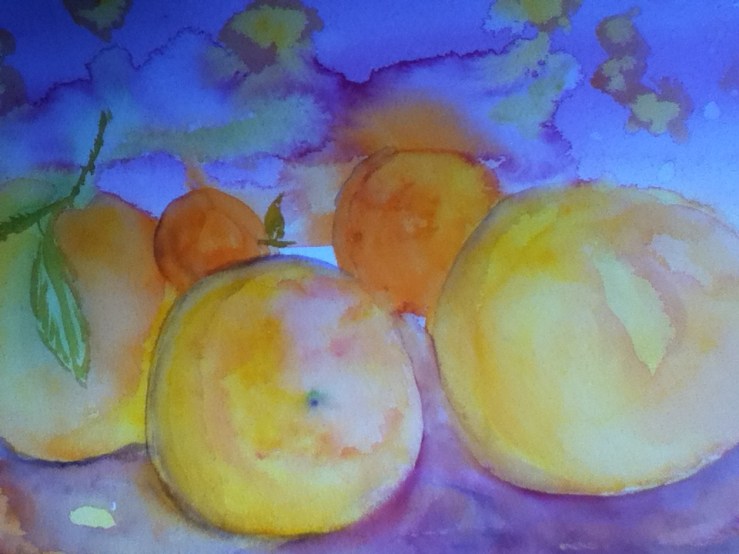
Grapefruit on the Table, watercolor by the poet

Why I am Not an Accountant

I look at grapefruit & sunflowers on the table &

see constellations of stars from the button-center blooms.

I think about what goes unsaid & see cars

in a junkyard that started with an old Buick in1956.

I dream up rhymes about a naiad rising

from the rippling moon & how she made a sad &

broody lad glad on a most mad & moonly night.

I move back into memory starting with 25:

25.       It was only 25 years ago the world split open

24.       when it did, words spilled

23.        from mouths like blood.

And end with lines about my birth.

2.         Thankfully, I still remember

1.         the joy of being born.

                                    Jacquelyn Markham (April 3, 2025)

It’s April & so begins 2025 National Poetry Month!

In the same way that Earth Day is everyday, poetry month is every month. Still, we do some extra special things in April, like attempt to write a poem a day and sometimes we use prompts from those who encourage us along the way!

Azaleas in bloom on April 1!

There are several sites who encourage us this way, and my favorite is: NaPoWriMo

Here’s what the guru behind NaPoWriMo had to say today on the start of the challenge:

Happy Tuesday, all, and Happy April 1. Today marks the start of another National/Global Poetry Writing Month!

“If it’s your first time joining us, the process is quite simple. Just write a poem every day during the month of April. 30 days means 30 poems. We’ll have an optional prompt every day to help you along, as well as a resource. We’ll also be featuring a participant each day. And if you’re interested in looking at other people’s poems, sharing links to your daily efforts, and/or cheering along, a great way to do that is by clicking on the title of each day’s post. That will take you to a page with a comment section for the day.” (Maureen)

I enjoyed the prompt for today found here: April 1 prompt:

I found a musical term that was new to me: the Rescue Opera, defined on the Naxos.com website like this: “The term ‘rescue opera’ has been used to describe operas such as Beethoven’s Fidelio, dealing with the subject of rescue, particularly, after 1789, from political victimisation.”

I think it an extraordinary time to write a poem about rescuing people from political victimisation. So, I have made note of it and will circle back around. In the meantime, I offer a triolet (one of my favorite forms because it is only 8 lines). Not to be fooled, however, (even tho it is April Fools Day) as it is not as simple as it seems with two refrains and two rhyme schemes. Here the Academy of American Poets defines the form for you: Triolet. It is a short poem with two refrains which gives it a kind of song-like rhythm and in fact is related to the rondeau.

So, because my time was short today on day 1, I’m sharing my Triolet and holding on to that first prompt for another day.

Enjoy your month of April as time does fly!

Time: A Triolet

Where does the time go?

I can certainly fritter it away!

If I knew the answer would I show

where does the time go?

Or, would I stop the clock or make it slow?

As if by doing that I could hold the day.

Where does the time go?

I can certainly fritter it away.

Jacquelyn Markham (c.2025)

Day 30 Heliodora: Gift of the Sun

What a wonderful time I have had with Maureen Thorson’s final prompt for 2024 poem-a-day challenge: “And now for our last prompt of the year – optional, as always! Today, we’d like to challenge you to write a poem in which the speaker is identified with, or compared to, a character from myth or legend. . .” Partly because I have revisited one of my all time favorite poets, H.D. (Hilda Doolittle), modern American poet. Partly because I have learned more about Heliodora, the first known woman astrologer, ca. 2nd or 3rd century.

H.D., as a young poet, courtesy Poetry Foundation
https://www.poetryfoundation.org/poets/h-d

Heliodora: Gift of the Sun

for H.D., priestess/poet

Heliodora, gift of the sun,

Heliodora, astrologer, were you

the only one?*

You charted Saturn, Mercury & Venus,

on papyrus positioned Jupiter & Mars. 

Heliodora, you prophesied births &

guided lovers by planets, by sun.

Heliodora, oracle of constellations,

the moon and its phases. You foretold

mysteries of eclipses, solar & lunar.

H.D., you, too, seeker & seer of mysteries,

poet/priestess, you divined

the memory of Heliodora.

Did she speak to you in a dream?

Did she prophesy in your “writing on the wall?”**

Did Heliodora appear in your “overmind?”

Heliodora, the ancient one,

send me a message through the stars,

the planets, the constellations,

Andromeda, Cygnus, Cassiopeia (the Queen)!

What do you seers foresee for me?

Jacquelyn Markham (4/30/2024)

Funerary Stele of Heliodora. Egyptian, 2nd–3rd CE***

*Archeology supports evidence of Heliodora, first known woman astrologer in the Greco-Roman world. **See Notes On Thought & Vision by H.D.

***Image of Heliodora courtesy of Missouri Museum of Art and Archeology

Day 29: I envy you your swiftness

painting of Mercury by John Woodrow Kelley

Hello poets & lovers of poetry! The penultimate day of our April 2024 poem-a-day challenge has arrived! For this day 29, the prompt asked us as to use as inspiration one of the ten most-used words of singer-songwriter Taylor Swift (really!) in her song lyrics. Her new album Tortured Poets Department hopefully doesn’t represent how we poets feel on Day 29 of the challenge, but we could use some of her publicity!

See the complete prompt from Maureen Thorson’s Napowrimo.net below the poem for more details. I must confess that my use of swift, swiftness, and swiftly was strictly coincidental! After all, I was writing about Mercury!

I envy you your swiftness

If only I were more like you, Mercury.

If only I were more mercurial—in the good sense,

quick-witted, sprightly, clever & ingenious.

Not temperamental, fickle or inconstant,

but swift with missives from the gods!

You wear sandals & a cap with wings

to propel you with a speed that others envy.

Like the planet that bears your name,

you travel lightning fast even escaping

Copernicus by traveling swiftly in the dark!

Not like a tree, rooted in earth,

not like a river running deep & slow,

not like me. I crawl like a caterpillar, a snail,

a turtle from the sea.  My mood sets in like

an overcast day when clouds don’t lift

until the sun burns through near sunset.

Oh, Mercury, though you be the god of tricksters

and thievery, and though the slow and steady

win the race, I envy you your swiftness!

            Jacquelyn Markham 4/29/2024

The Prompt:

From Napowrimo.net: “And now for our optional prompt. If you’ve been paying attention to pop-music news over the past couple of weeks, you may know that Taylor Swift has released a new double album titled “The Tortured Poets Department.” In recognition of this occasion, Merriam-Webster put together a list of ten words from Taylor Swift songs. We hope you don’t find this too torturous yourself, but we’d like to challenge you to select one these words, and write a poem that uses the word as its title.”

Jacquelyn Markham, poet & writer, author of Rainbow Warrior, Finishing Line Press (2023), Peering Into the Iris: An Ancestral Journey and China Baby, among other titles.

Day 28 Amaryllis Pulse: A Sijo

Happy Sunday everyone! Be good to your muse today! She has been very busy and mostly faithful!

After today’s Sijo, only two more days of the poem-a-day challenge. We are almost there!

Today’s poem is an adventure in counting syllables! And a learning experience.

Mine has 47 syllables, the lines are 16, 16, & 15. This traditional Korean verse form usually has three lines of 14-16 syllables, so I’m within the range. (It is pronounced SHEE-jo.) It’s a little more complicated than just the syllables, so check it out, if you want to know more. I found an excellent guide from Koreanquartly.org—A basic guide to writing sijo, in case you want to try writing one.

The Prompt behind the Poem:

Napowrimo.net: Finally, our optional prompt for the day asks you to try your hand at writing a sijo. This is a traditional Korean verse form. A sijo has three lines of 14-16 syllables. The first line introduces the poem’s theme, the second discusses it, and the third line, which is divided into two sentences or clauses, ends the poem – usually with some kind of twist or surprise.

You could also write a sijo in six lines – at least when it comes to translating classical sijo into English, translators seem to have developed this habit, as you can see from these translations of poems by Jong Mong-Ju and U Tak.

Take a look at this energetic group of women, HerBeat, playing traditional Korean drums! What a pulse of energy like the Amaryllis!!

HerBeat, Korean Women Drummers

Poet, writer, painter, and player of music, I love to express myself and invite your visits and comments to my site. Jacquelyn View all posts by Poet Voice

Day 27 my lover courage: an American sonnet

Today, as part of the poem-a-day challenge, we wrote an American sonnet. Still 14 lines as the traditional sonnet, but much freer in meter and rhyme.

I used Maureen Thorson’s (Napowrimo.net) suggested prompt & formula from Write253.com (shared below).

It was a welcome prompt on this Day 27 of our challenge. I also tried a new way of presenting the poem on my blog. I am pretty pleased with the outcome. The inspiration from songs or musical genres (part of the process) was the deep emotional song by Melody Gardot (also linked below). Like Frida Kahlo, Gardot was injured in a serious accident at a very young age (bus for Kahlo and bicycle for Gardot). Painting saved Frida and music saved Melody.

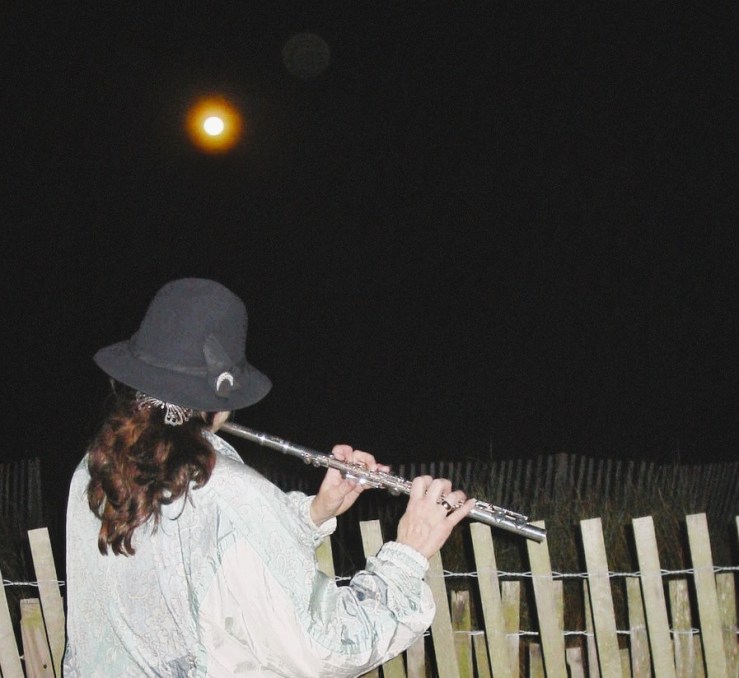
poet playing flute from the heart, Penn Center, ca. 2008

The Prompt: And now for our prompt – optional, as always!  Today we’d like to challenge you to write an “American sonnet.” What’s that? Well, it’s like a regular sonnet but . . . fewer rules? Like a traditional Spencerian or Shakespearean sonnet, an American sonnet is shortish (generally 14 lines, but not necessarily!), discursive, and tends to end with a bang, but there’s no need to have a rhyme scheme or even a specific meter. Here are a few examples:

If you’d like more specific instructions for how to get started, Write 253 has a great “formula” prompt for an American sonnet, which you can find here.

Jacquelyn Markham, poet & writer, author of Rainbow Warrior, Finishing Line Press (2023), Peering Into the Iris: An Ancestral Journey and China Baby, among other titles. She offers writing & creativity guidance through Moonflower Mentoring.