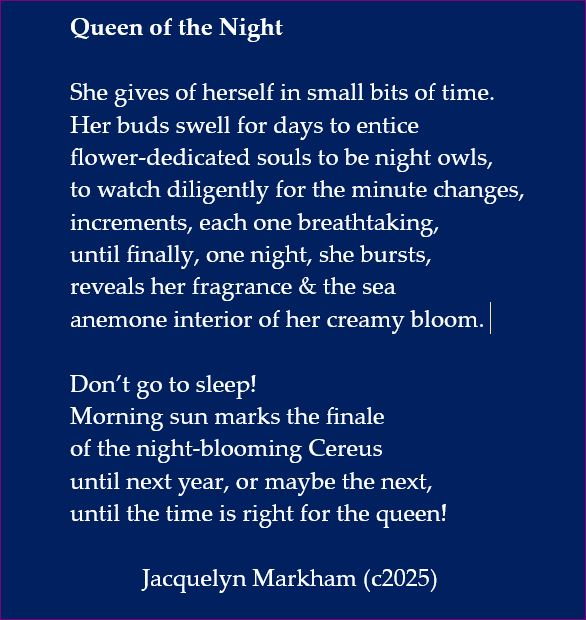
I suppose you may be thinking that Poet Voice indulged in a rather long sabattical after we buttoned up April 2025 Poem-a-day challenge. Though I haven’t been totally resting on my laurels, I have taken a bit of a break from blogging—longer than I had really intended! I haven’t given up my creative life, however, and even wrote some short verses, one that I have shared with you now, “Queen of the Night.” Of course, I was flower-dedicated and watched the night long blooming of the Epiphyllum oxypetalum or commonly called “Queen of the Night.”
Remember that Vision Plan we started two years ago? With the Mercury Retrograde return, it seems appropriate to revisit our Vision Plans.
Now, as we are nearing that cross quarter point between summer and fall, often called Lammas (in the northern/western hemisphere of the US), there is still plenty of hot weather throughout many parts of the world. I don’t know about you, but climate change is never far from my mind! Despite the heat, however, we can focus on our creativity if we are one of those folks lucky enough to dodge the heat inside an air conditioned home. So, let’s return to our Vision Plan! Also, may I ask that you focus on world peace and kindness every day, so our collective energy can manifest them in our own lives and beyond.
Thank you! And, before we wrap-up July and spin around August, let us take time to check the short-term goals we set for ourselves some time ago in our personal Vision Plans. We are still experiencing Mercury Retrograde throughout the middle of August, so it is a good time to **revisit** our plans.
To refresh our memories, below is a quick review and step-by-step process of creating a Vision Plan:
Step 1: Write your vision statement. Your vision statement is futuristic and should inspire you. Mine is only three sentences long and I’ve written it in gold ink at the top of a new page in my journal.
Step 2: Next, write your mission statement which differs from but grows out of your vision statement. There are many resources on this process of writing a mission statement (search Strategic Plan) but think simply. What is it you do or want to do everyday? Focus on the present. Keep it brief.
Step 3: Now, short term goals that fit within your vision and your mission. I settled on five, but worked through several pages of writing to see the difference in the goals and the tasks it would take to accomplish them. You could focus on three, or more if you are energetic, but I suggest no more than seven. Can some of the short term goals be moved to long term goals, for example?
Step 4: The details, the tasks, the baby steps! What tasks will be needed to meet these goals? (You can break up tasks to smaller baby steps, too.)
Step 5:Create a timeline and in January 2026, review and revise for the new year!
Now that you have carved out the details of your Vision Plan, enjoy the full moon in Aquarius (which is also Lunar Lammas). Collaborate and network while the moon is full in Aquarius. And always, always, celebrate the fullness and beauty of the full moon and your own accomplishments coming to fruition over time, not unlike the Queen of the Night!
And remember to celebrate your vision plan for the creativity in your life!
Today’s challenge was “to write a poem that involves music at a ceremony or event of some kind.” Click (NaPoWriMo) for all the details about the Day 28 prompt. Only two more days of the poem-a-day challenge and National Poetry Month!
And here’s my offering for the Day 28 challenge about music at a ceremony. In this case, my own experiences playing music for weddings!
Day 24 PAD 2025NapoWriMo’s prompt for today brought to mind a rather dissonant duet from days past. I think you will see what I mean.
And the challenge is to write a poem that involves people making music together, and that references – with a lyric or line – a song or poem that is important to you.
Here’s my April 24 offering amidst a busy, busy National Poetry Month!
The prompt from NapoWriMo for Day 22 took me back to a time when I learned to play the flute.
Having come from a rural one-room schoolhouse with few resources and moving to a small town highschool as a 7th grader, I arrived without any musical background. The kids at the “city” school started music in 5th grade, so my band director (if only I remembered his name) was kind enough to try to bring me up to speed along with another student who learned the French Horn! That band director surely has received his reward in heaven!
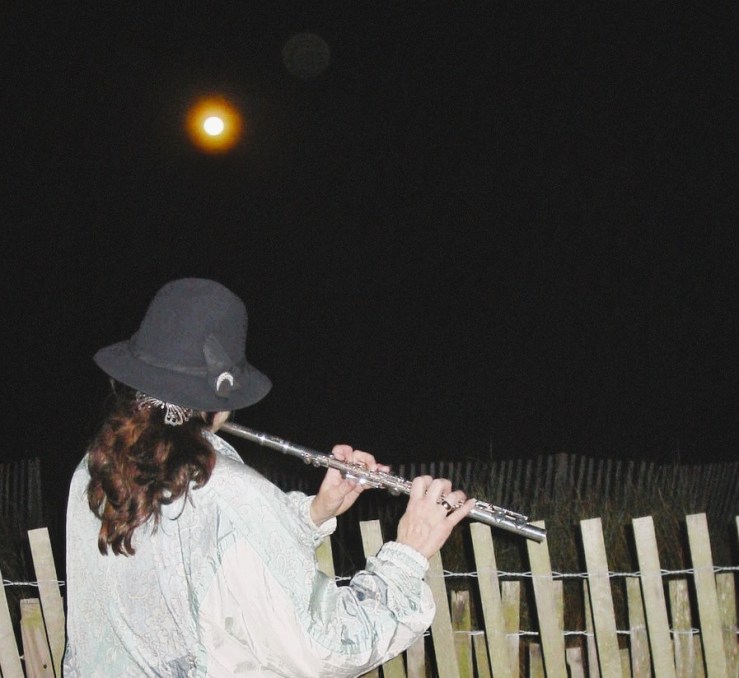
Poet with Flute Serenading the Moon
Also, I highly recommend you read Diane Wakoski’s poem that is embedded within the prompt, too. It is lovely!
Prompt: “In her poem, Thanking My Mother for Piano Lessons, Diane Wakoski is far more grateful than I ever managed to be, describing the act of playing as a “relief” from loneliness and worry, and as enlarging her life with something beautiful. Today, we’d like to challenge you to write a poem about something you’ve done – whether it’s music lessons, or playing soccer, crocheting, or fishing, or learning how to change a tire – that gave you a similar kind of satisfaction, and perhaps still does.”
Hope you enjoy writing a poem about what you learned joyfully!
Day 16, Poem-a-Day Challenge (a poem after Blue Bayou)
Here’s the prompt: Today’s prompt asks us to “imagine music in the context of a place, but more along the lines of a soundtrack laid on top of the location, rather than just natural sounds. Today, try writing a poem that similarly imposes a particular song on a place. Describe the interaction between the place and the music using references to a plant and, if possible, incorporate a quotation – bonus points for using a piece of everyday, overheard language.”
You can visit Napowrimo, Day 16, to learn more details. Meanwhile, here’s my poem, under the wire on Day 16 of the poem-a-day challenge for National Poetry Month, 2025!
…here’s our prompt for the day (optional, as always). Donald Justice’s poem, “There is a gold light in certain old paintings,” plays with both art and music, and uses an interesting and (as far as I know) self-invented form. His six-line stanzas use lines of twelve syllables, and while they don’t use rhyme, they repeat end words. Specifically, the second and fourth line of each stanza repeat an end-word or syllable; he fifth and sixth lines also repeat their end-word or syllable. Today, we challenge you to write a poem that uses Justice’s invented form.
I found that the lines in Justice’s invented form varied from ten to thirteen syllables rather than always 12 syllables, soI did the same with my response and varied line length. Also, I wrote only one stanza of the required six lines as no length was set. Perhaps more to come!
Lunatics
Out from the rivered horizon the moon glows pink-gold.
We waited, yet nearly missed, as in silence it rose.
Across the way, the sunset in a sky of color,
a backdrop of azure splashed in red & rose.
On earth, our moods feel the presence of the moon.
Although we were given the opportunity to write a “loose” villanelle today, I went with the traditional rhyme scheme. You will find the rules for this form linked below, courtesy of the Academy of American poets.
From NaPoWriMo, my favorite poem-a-day challenge website, Maureen Thorson offered this optional prompt: “Take a look at Kyle Dargan’s “Diaspora: A Narcolepsy Hymn.” This poem is a loose villanelle that uses song lyrics as its repeating lines (loose because it doesn’t rhyme). Your challenge is, like Dargan, to write a poem that incorporates song lyrics – ideally, incorporating them as opposing phrases or refrains.”
From Nina Simone’s Song “For All We Know” from NinaSimone.com
This might only be a dream *first refrain Like the ripples, like the ripples in the stream *second refrain
Villanelle: A1 b A2 / a b A1 / a b A2 / a b A1 / a b A2 / a b A1 A2.
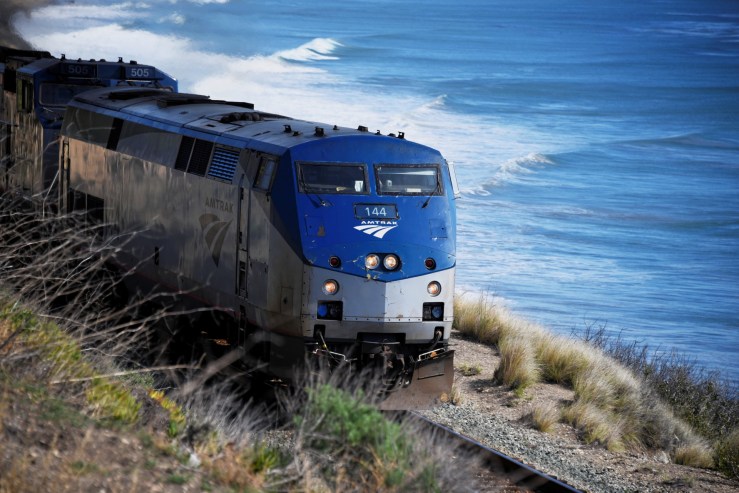
Like a train a track that stretches ahead, the days blur by and we are now on Day 9 of the April poem-a-day challenge, chugging away toward the middle of the month. Below is the optional prompt from Maureen at the NaPoWriMo poetry site. This prompt is all about Rhyme & Sound which brought to my mind, a train ride.
“And here’s our optional prompt for the day. Like music, poetry offers us a way to play with and experience sound. This can be through meter, rhyme, varying line lengths, assonance, alliteration, and other techniques that call attention not just to the meaning of words, but the way they echo and resonate against each other. For a look at some of these sound devices in action, read Robert Hillyer’s poem, Fog. It uses both rhyme and uneven line lengths to create a slow, off-kilter rhythm that heightens the poem’s overall ominousness. Today we’d like to challenge you to try writing a poem of your own that uses rhyme, but without adhering to specific line lengths. For extra credit, reference a very specific sound, like the buoy in Hillyer’s poem.”Maureen Thorson
“Cinnamon” is a poem I wrote in response to Day 6 prompt of Poem-a-Day 2025 (30 Poems in 30 days). Check it out!
Now, dear readers, how did I come up with this odd poem? Why yes, it was the day 6 prompt that gave us so many choices and directions to go by . Please, visit NaPoWriMo to get all details, but basically, you choose a number from the chart which leads to a taste that becomes the title and two more words to work in. In my case, wheeze and golden were the words.
The poem starts out lovely with a sweet-smelling scent, but alas, like so many wonderful things in our modern world, the spice turned toxic. Not all, of course, but be mindful! Still, cinnamon has some health benefits according to some reports, like these claims from Cleveland Clinic.
And then, we may want some retro music to accompany our latte, so here it is! Neil Young’s “Cinnamon Girl.”