Queen of the Night & Vision Plan

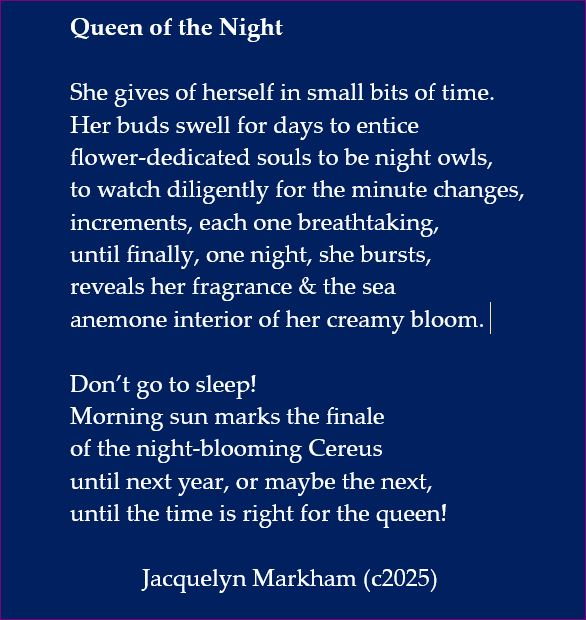
Queen of the Night

Hello dear Poet Voice readers,

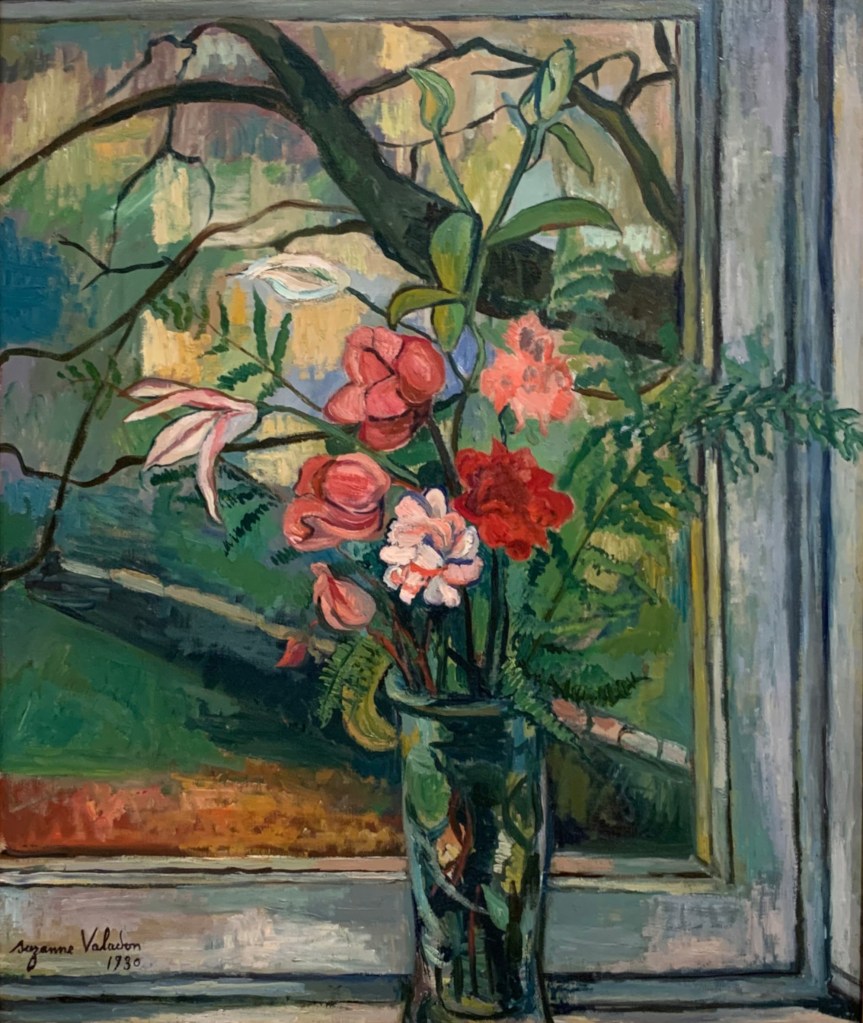
I suppose you may be thinking that Poet Voice indulged in a rather long sabattical after we buttoned up April 2025 Poem-a-day challenge. Though I haven’t been totally resting on my laurels, I have taken a bit of a break from blogging—longer than I had really intended! I haven’t given up my creative life, however, and even wrote some short verses, one that I have shared with you now, “Queen of the Night.” Of course, I was flower-dedicated and watched the night long blooming of the Epiphyllum oxypetalum or commonly called “Queen of the Night.”
Remember that Vision Plan we started two years ago? With the Mercury Retrograde return, it seems appropriate to revisit our Vision Plans.

Now, as we are nearing that cross quarter point between summer and fall, often called Lammas (in the northern/western hemisphere of the US), there is still plenty of hot weather throughout many parts of the world. I don’t know about you, but climate change is never far from my mind!  Despite the heat, however, we can focus on our creativity if we are one of those folks lucky enough to dodge the heat inside an air conditioned home. So, let’s return to our Vision Plan!  Also, may I ask that you focus on world peace and kindness every day, so our collective energy can manifest them in our own lives and beyond.

Thank you! And, before we wrap-up July and spin around August, let us take time to check the short-term goals we set for ourselves some time ago in our personal Vision Plans. We are still experiencing Mercury Retrograde throughout the middle of August, so it is a good time to **revisit** our plans.

To refresh our memories, below is a quick review and step-by-step process of creating a Vision Plan:

Step 1: Write your vision statement. Your vision statement is futuristic and should inspire you. Mine is only three sentences long and I’ve written it in gold ink at the top of a new page in my journal.

Step 2: Next, write your mission statement which differs from but grows out of your vision statement. There are many resources on this process of writing a mission statement (search Strategic Plan) but think simply. What is it you do or want to do everyday? Focus on the present. Keep it brief.

Step 3: Now, short term goals that fit within your vision and your mission. I settled on five, but worked through several pages of writing to see the difference in the goals and the tasks it would take to accomplish them. You could focus on three, or more if you are energetic, but I suggest no more than seven. Can some of the short term goals be moved to long term goals, for example?

Step 4: The details, the tasks, the baby steps! What tasks will be needed to meet these goals? (You can break up tasks to smaller baby steps, too.)

Step 5:  Create a timeline and in January 2026, review and revise for the new year!

Now that  you have carved out the details of your Vision Plan, enjoy the full moon in Aquarius (which is also Lunar Lammas).  Collaborate and network while the moon is full in Aquarius.  And always, always, celebrate the fullness and beauty of the full moon and your own accomplishments coming to fruition over time, not unlike the Queen of the Night! 

            And remember to celebrate your vision plan for the creativity in your life!

Where Trains Go

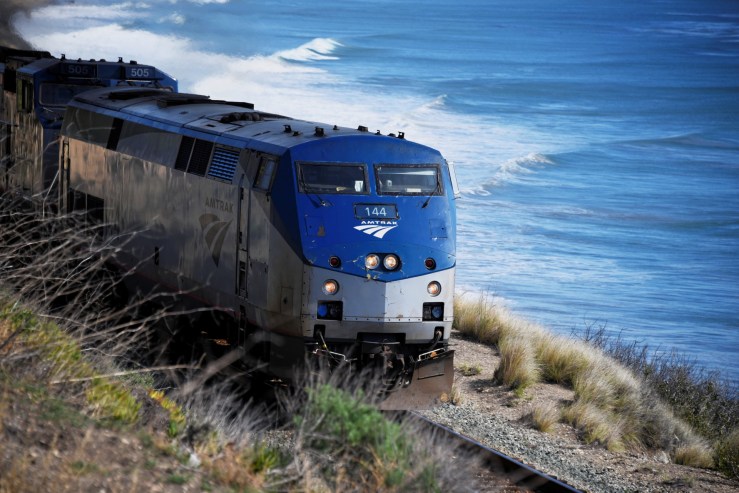
Like a train a track that stretches ahead, the days blur by and we are now on Day 9 of the April poem-a-day challenge, chugging away toward the middle of the month. Below is the optional prompt from Maureen at the NaPoWriMo poetry site. This prompt is all about Rhyme & Sound which brought to my mind, a train ride.

And here’s our optional prompt for the day. Like music, poetry offers us a way to play with and experience sound. This can be through meter, rhyme, varying line lengths, assonance, alliteration, and other techniques that call attention not just to the meaning of words, but the way they echo and resonate against each other. For a look at some of these sound devices in action, read Robert Hillyer’s poem, Fog. It uses both rhyme and uneven line lengths to create a slow, off-kilter rhythm that heightens the poem’s overall ominousness. Today we’d like to challenge you to try writing a poem of your own that uses rhyme, but without adhering to specific line lengths. For extra credit, reference a very specific sound, like the buoy in Hillyer’s poem.” Maureen Thorson

Thank you for visiting Poet Voice!

Jacquelyn ~

Cinnamon

Kind of light and fun for a sixth day of the Poem-a-day challenge. How are you doing out there poets and writers and appreciaters of art?

Cinnamon

A dash of this spice

in my coffee, cream makes it

oh so golden

with a tingle of chai

but if it’s too heavy

it could make me wheeze

and if it’s too light

just a pinch makes me sneeze.

Like nutmeg, the benefits are great,

good for insomnia &

good for the skin.

Come fall, in the states

folks love pumpkin lattes

even if temps have not fallen.

The use of this spice goes back a long way!

3,000 years ago the sweet-smelling

spice was used to embalm the dead.

All of these uses give this spice

a noteworthy name—

until in our modern age

studies found lead in it.

Jacquelyn Markham ©2025

“Cinnamon” is a poem I wrote in response to Day 6 prompt of Poem-a-Day 2025 (30 Poems in 30 days). Check it out!

Now, dear readers, how did I come up with this odd poem? Why yes, it was the day 6 prompt that gave us so many choices and directions to go by . Please, visit NaPoWriMo to get all details, but basically, you choose a number from the chart which leads to a taste that becomes the title and two more words to work in. In my case, wheeze and golden were the words.

The poem starts out lovely with a sweet-smelling scent, but alas, like so many wonderful things in our modern world, the spice turned toxic. Not all, of course, but be mindful! Still, cinnamon has some health benefits according to some reports, like these claims from Cleveland Clinic.

And then, we may want some retro music to accompany our latte, so here it is! Neil Young’s “Cinnamon Girl.”

Neil Young, “Cinnamon Girl”

All poems brought to you by Poet Voice (J. Markham).

This Tango Between Us

photo by poet

Hello lovers of art, music, & poetry!

Today, please visit the NaPoWriMo prompt for Day 5 here as it is a bit complicated, but fun:

From a chart provided, choose first a Musical notation–mine was to play like “you are about to start crying,” but I added Rubato because I love it (giving me the chance to slow down and pick up the tempo to express my emotions!).  Rubato allows performers to add a personal touch to the music, with emphasis on emotional expression.

Then, we were to choose a genre (I chose the Tango!) and finally, a few words from a list. Being a hopeless romantic, I selected moonlight & roses.

And, here’s my poem for today.

This Tango Between Us

this tango between us makes me feel like

I am about to start crying

or it could be the moonlight in rubato

as the big bright sphere floats behind the clouds

then surprises with radiance when dark puffs fall away

crescendoing from a slow sweet tango

to a wild tarantella in 6/8 time!

I still want to cry though

as roses drop from the sky

because it is so beautiful—

this tango between us.

            Jacquelyn Markham(c)2025

photo by poet

Weaving a Golden Web

A golden orb weaver has moved into a corner of my front verandah and seems quite at home there. She looks as if she has no intentions of ever moving away. Though surely a gift from the universe, if any of you have ever seen this spider, you know that she can be a bit daunting!

According to one website, a group of writers and entymologists who created it out of a labor of love, the golden orb weaver is a “fascinating spider known for its intricate, large webs that shimmer like gold in the sunlight.”

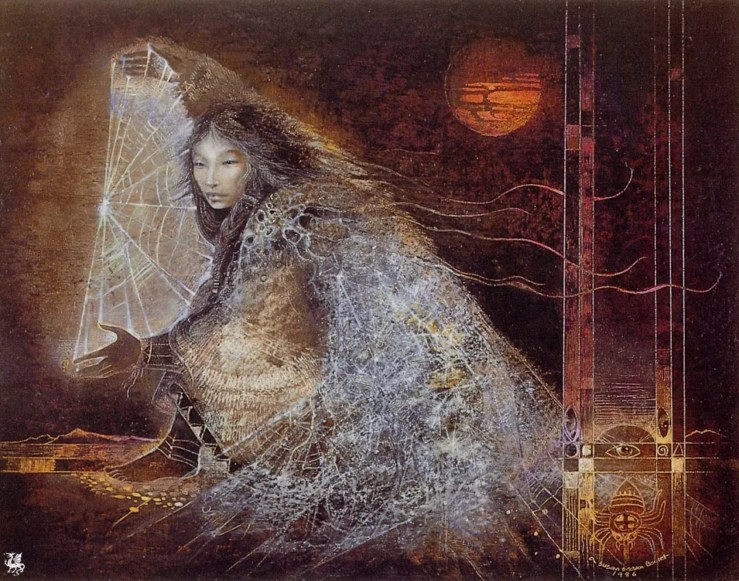
Spider Woman Goddess, Susan Seddon Boulet

(By the way, if you visit, what’sthatbug.com, be sure to click on the ads which, they explain, help to “generate revenue to pay for hosting, expert entomologists, and bandwidth costs when visitors click on ads on our site.”)

So, alleviating any fears I may have of the amazing golden orb weaver, the information from these entomologists is of interest: “orbweaver spiders are generally non-threatening creatures that pose little risk to humans.” I have noticed that this very large spider is completely oblivious to my presence even when I am watering my porch plants nearby. Whatsthatbug.com continues its “interaction with humans” details: “Their venomous bites are usually harmless, and they exhibit docile behavior in their natural habitats.” For sure, I will not be putting my hand into the web and the Golden Orb Weaver is a very busy spider! She has no time for the likes of me. So, I turn to my usual approach, the symbolism of this “animal spirit.”

Jamie Sams & David Carson in The Discovery of Power Through the Ways of Animals, a guide that accompanies my deck of medicine cards (Bear & Company, Santa Fe, NM), says: “Spider is the female energy of the creative force that weaves the beautiful designs of life.. .If Spider has dropped into your cards (or life, my italics), she may be telling you to create, create, create.”

Spider Woman, popular culture notwithstanding, has been a powerful symbol in some American Indian cultures (Navaho & Hopi), for example, “Spider Woman represented wisdom and education,” according to encyclopedia.com. She is associated with crops, weaving and the goddess as “a symbol of the ability to weave and to create something from one’s own body, just as a spider makes silk” (encyclopedia.com).

Susan Seddon Boulet created a powerful image of spiderwoman goddess.
Image credit: https://arthive.com/artists/10191~Susan_Seddon_Boulet/works/284690~Shaman_Spiderwoman

So, what does my symbol tell me today? Create, create, create & remember the sheer wonder of our world!

Golden Orb Weaver Spider

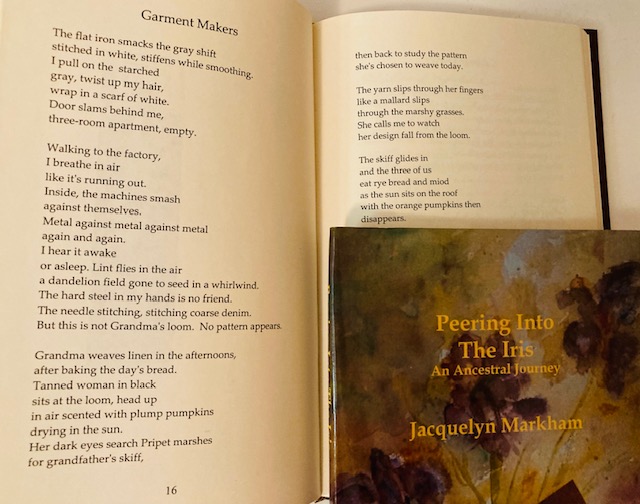
And, dear readers, I will end with a poem from my book Peering Into the Iris: An Ancestral Journey, that tells a story of my ancestors & their weaving.

Poem & Image by poet, Jacquelyn Markham

Get in Touch

Jacquelyn is always available for readings and mentoring poets and writers. If you want to chat about poetry, books, or creativity, don’t hesitate to reach out, make a comment, or send an email to: jacquiepoet3@gmail.com

Gladioli from my Garden Against “Abstract Marsh”

(Acrylic on stretched canvas, painted by the author on retreat at Penn Center, St. Helena, SC, ca. 2003)

The continuity of art reveals itself more each year.  Images, colors, and themes recur in our writing, painting, photography, cooking, and gardening.  So, by chance, when I cut the gladioli from my June garden and placed it in a vase, it gravitated to a painting on my wall.  So many times, I have seen in nature like attracts like, for example, yellow butterflies light on yellow flowers.

But, back to the continuity of art.  Even in cooking, for example, I have sour dough starter in my refrigerator right now, a baking theme from many years ago when sour dough enjoyed another popularity trend. So, when I was baking bread a week or so ago, I pulled out a poem titled “Bread-Baking” from my collection Lavender Blooms Turn Eggplant Purple (there’s that recurring color!) After some searching, I found the poem and revised it. I’ll share some lines with you here.

Thinking the bread-baking might restore

the home my vagabond dreams threaten,

I set the yeast & the flour in action.

Fingers knead the dough,

punch, pull, stretch until

finally, I shape a smooth loaf,

place it in the bowl,

cover with clean linen.

Time now for its rising.

I wonder as I rest,

steaming tea to my lips,

leaves rustling outside the window,

how yeast turns flour to bread &

what leaven would so wonderfully

transform the early days

into sustenance for the soul?

Jacquelyn Markham (excerpt Bread-Baking)

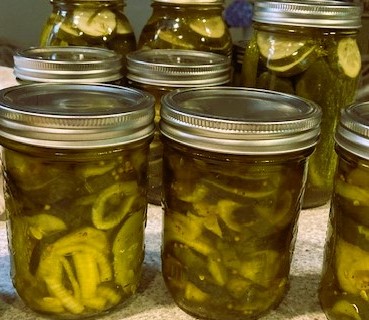
And, now, it’s June and in my region along with the stunning purple & wine gladioli, we enjoy the abundance of vegetable gardens. So, the other day, I relived another poem, from another time, “Today This Jar of Pickles is My Poem.” This poem became the title poem of a chapbook of the same name that placed as a finalist in a chapbook contest sponsored by what was then Armstrong State College in Savannah (now Georgia Southern University).

from the poem:

I struggle with domesticity

as I sterilize jars, clear

pack fresh cucumbers, garlic

sharp smelling dill

breathe steaming vinegar

vapor that unclouds the brain

Lids bounce in boiling water

I fish for one and quickly seal

each jar, this could be a poem

each jar, this a painting

each jar, I question

and justify

 . . .

On gray winter days

sculptures in glass on my shelf

green peppers and cayennes twist in to form

zucchinis and crookneck yellows

wind, curve around each other

speckled beans, mosaics

I take down jar after jar

chill or heat the colors

shapes, lines

patterns that turn to food and are eaten

Jacquelyn Markham

            (excerpt from “Today This Jar of Pickles is My Poem”)

So, today, look around you.  Do you see the continuity of art around you? And, the continuity of  your life?

Jacquelyn~ aka Poet Voice

“Deep Purple,” a song that keeps coming back around

Day 29: I envy you your swiftness

painting of Mercury by John Woodrow Kelley

Hello poets & lovers of poetry! The penultimate day of our April 2024 poem-a-day challenge has arrived! For this day 29, the prompt asked us as to use as inspiration one of the ten most-used words of singer-songwriter Taylor Swift (really!) in her song lyrics. Her new album Tortured Poets Department hopefully doesn’t represent how we poets feel on Day 29 of the challenge, but we could use some of her publicity!

See the complete prompt from Maureen Thorson’s Napowrimo.net below the poem for more details. I must confess that my use of swift, swiftness, and swiftly was strictly coincidental! After all, I was writing about Mercury!

I envy you your swiftness

If only I were more like you, Mercury.

If only I were more mercurial—in the good sense,

quick-witted, sprightly, clever & ingenious.

Not temperamental, fickle or inconstant,

but swift with missives from the gods!

You wear sandals & a cap with wings

to propel you with a speed that others envy.

Like the planet that bears your name,

you travel lightning fast even escaping

Copernicus by traveling swiftly in the dark!

Not like a tree, rooted in earth,

not like a river running deep & slow,

not like me. I crawl like a caterpillar, a snail,

a turtle from the sea.  My mood sets in like

an overcast day when clouds don’t lift

until the sun burns through near sunset.

Oh, Mercury, though you be the god of tricksters

and thievery, and though the slow and steady

win the race, I envy you your swiftness!

            Jacquelyn Markham 4/29/2024

The Prompt:

From Napowrimo.net: “And now for our optional prompt. If you’ve been paying attention to pop-music news over the past couple of weeks, you may know that Taylor Swift has released a new double album titled “The Tortured Poets Department.” In recognition of this occasion, Merriam-Webster put together a list of ten words from Taylor Swift songs. We hope you don’t find this too torturous yourself, but we’d like to challenge you to select one these words, and write a poem that uses the word as its title.”

Jacquelyn Markham, poet & writer, author of Rainbow Warrior, Finishing Line Press (2023), Peering Into the Iris: An Ancestral Journey and China Baby, among other titles.

Day 26 Tango haiku & Be Brave cinquain

Greetings poets & lovers of poetry!

Today’s prompt guided us poets to use several poetic sound techniques—alliteration, consonance, and assonance.  I added to that a couple of small poetic forms: the haiku (3 lines of 5, 7, 5 syllables) and the cinquain (5 lines of 2,4,6,8,2 syllables). Fun!

The Prompt from Napowrimo.net: “And now for our (optional) prompt. Today, we’d like to challenge you to write a poem that involves alliteration, consonance, and assonance. Alliteration is the repetition of a particular consonant sound at the beginning of multiple words. Consonance is the repetition of consonant sounds elsewhere in multiple words, and assonance is the repetition of vowel sounds. Traci Brimhall’s poem “A Group of Moths” provides a great example of these poetic devices at work, with each line playing with different sounds that seem to move the poem along on a sonorous wave.”

Tango Till: Haiku

Mango, mango, will

you do the tango till dawn?

Tango me all night.

            Jacquelyn Markham 4/26/24

Be Brave: Cinquain

O blue

melancholy

mood melancholy me

sun sparks diamonds on blue river

be brave.

            Jacquelyn Markham 4/26/24

Moonflower Mentoring:

Nurture Creativity
Foster Writing Practice
Inspire New Material
Guide Current Projects
Review Mentee’s Work

Dr. Markham uses a variety of approaches to suit each person’s creative process:one-on-one, workshops, and/or intensive programs.In person and virtual options available. To learn more about Moonflower Mentoring:Email: Moonflower Mentoring at jacquiepoet3@gmail.com

Day 15 Little Stamp from Aruba

Today’s prompt from Napowrimo.net asked us to get inspired by stamps!

It took me awhile as first I went to the National Postal Museum and there was so much to learn! Next, I tried the recommended @StampsBot. Like Maureen said, there was an amazing “wide, wonderful, and sometimes wacky world of postage stamps” out there! But, still, difficult to zero in on just one. Curious how many stamps from other countries feature cats. I don’t recall any US stamps giving cats so much attention. In the end, though, it was this gorgeous palm tree and sunset that caught my eye. And now, I want to go to Aruba!

It also reminded me of a painting I did en plein air, years ago on a nearby beach. I gave it as a wedding gift to some dear friends.

Poet’s painting of island sunset.

And here is my little poem inspired by this lovely stamp from Aruba:

On this little stamp from Aruba

a fireball drops into the sea

a palette of orange red & yellow

sinks deep into the waves

yet stays in sky & palm fronds

not wanting to give up

the glorious day in Aruba

on the turquoise Caribbean

or even the quiet day

at the shore nearby

Jacquelyn Markham (4/15/2024)

Aruba from https://www.aruba.com/us

Sparking creativity:A multi-dimensional Approach

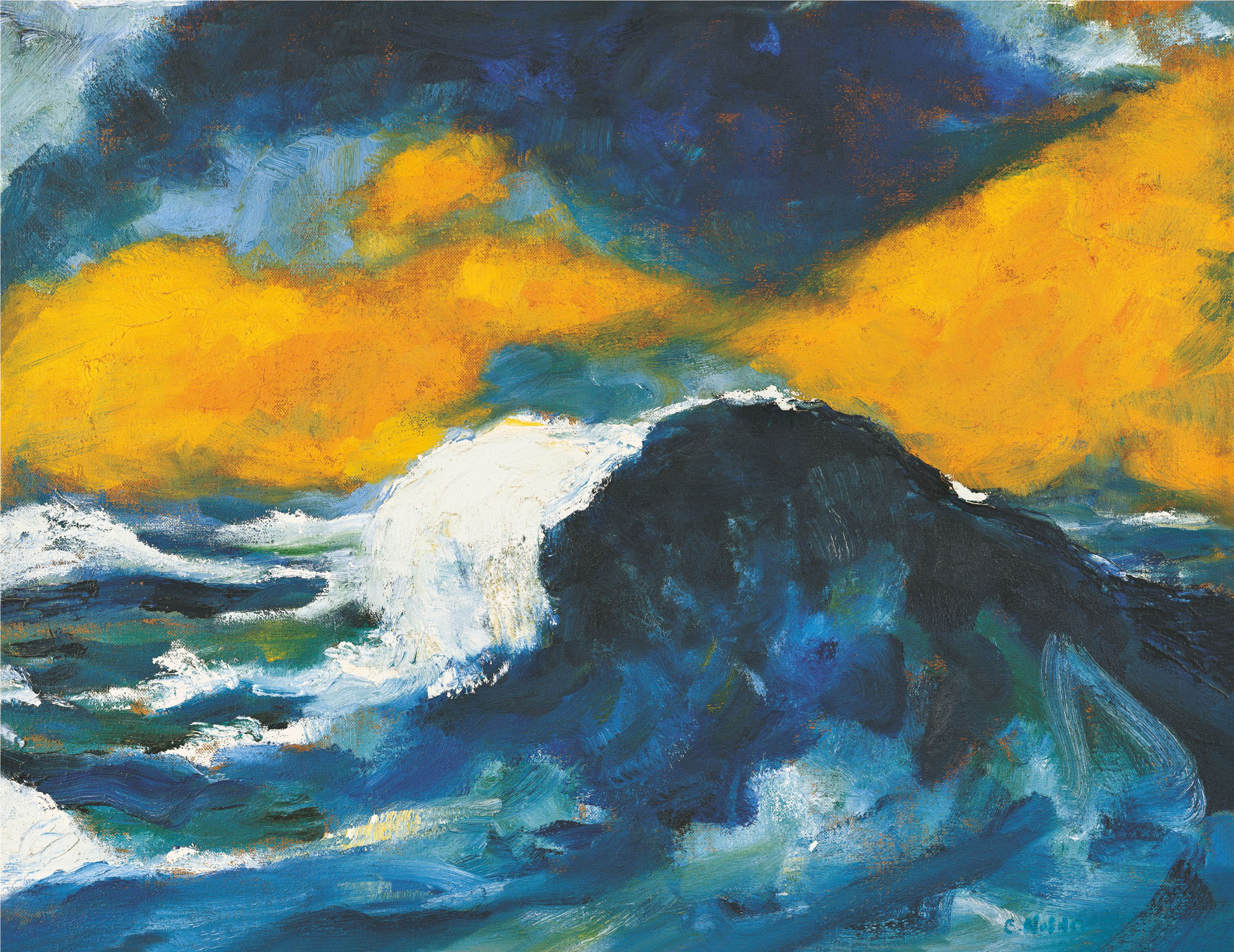
“The Sea,” Emile Nolde

Bonjour, Creatives!

Does your creative process need a spark? I want to share an approach that taps into your own talents and skills and hopefully will engage some creativity that has gone dormant! I am suggesting a multi-genre or multi-dimensional approach to experiencing your creativity. This approach requires a bold spirit with no bounds on your creative process. Are you ready?

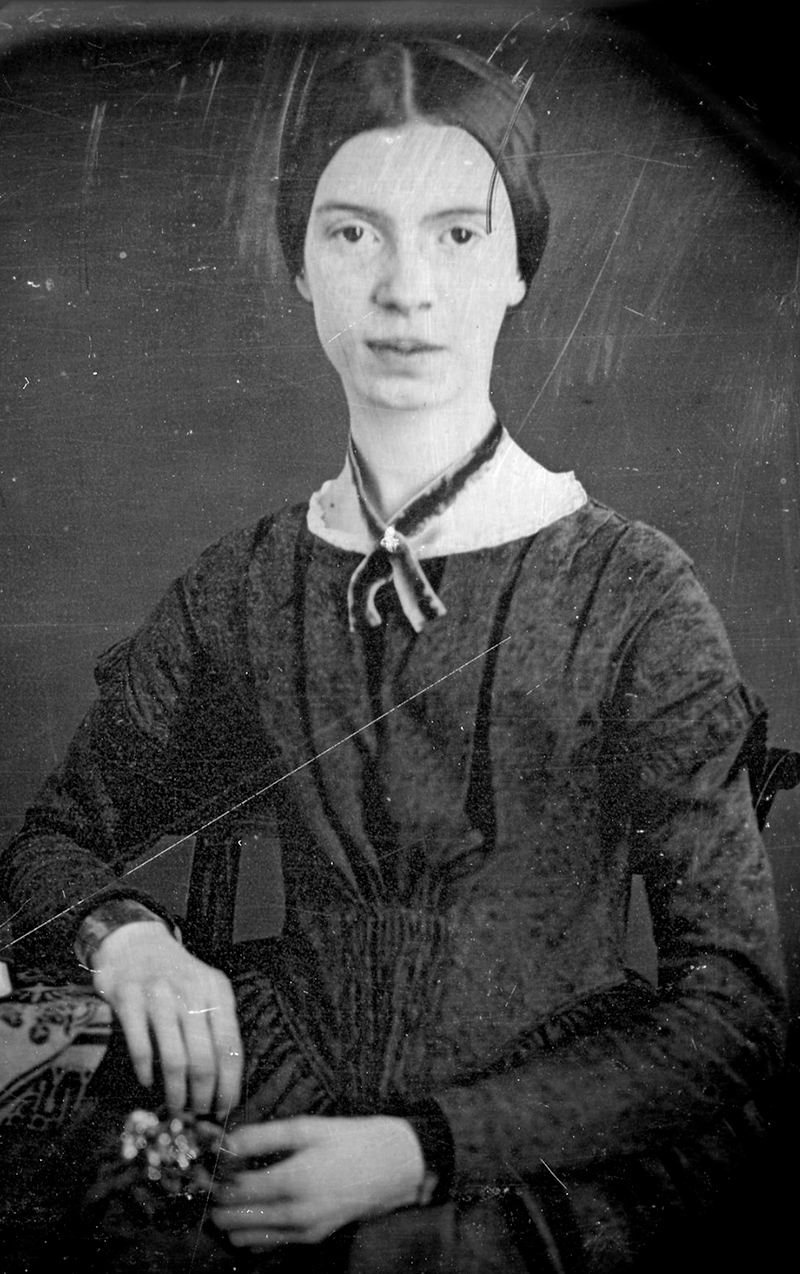
Here’s the way: work with one or more genres of your choice for a multi-dimensional experience of whatever you choose to create. All that is required is a willingness to “dwell in possibility,” as Emily Dickinson did, and embrace the creative process.

First, select a favorite song, painting, poem, story, etc. Next, interpret that work of art in another genre. For example, if you are a painter, create a new painting that interprets a poem or a photograph or a story. A poem may inspire an oral interpretation performance, a dance, a music composition, a drama or even a puppet show!

Sam and Friends, 1955, by Jim Henson

For fun, I explored an interpretation of music with composing and flute playing inspired by Emily Dickinson. My first impromptu musical composition reflected the playfulness of the lines “Two butterflies went out at noon/And waltzed above a stream./Then stepped straight through the firmament/And rested on a beam.” You can imagine the fun I had in playing those two butterflies at noon! When my effervescent energy ran out, I shifted to a minor key for the more foreboding lines “Because I could not stop for Death,/He kindly stopped for me;/The carriage held but just ourselves/And Immortality.” Not to dwell too long on that heavy energy, I decided on the sensual and mysterious lines of “Wild nights! Wild nights!” Click here for the poem provided by The Poetry Foundation including a 33 second recording!

Emily Dickinson image, courtesy of the Emily Dickinson Museum

So, I am delving into the poem “Wild nights! Wild nights” in a new way with a musical tone poem to illustrate how this genre bending exercise illuminates the poem with music.

To do this, I chose to use the key of G major because of its key signature with one sharp (F sharp). Note: this may vary from an F to an F sharp, depending on the source. While many “new age” followers are aware of the penetrating power of F#; others may not be, and actually the theory of F# opening the heart chakra goes back to the chanting of monks and is not an arbitrary choice. For this reason, my new experience of Dickinson’s familiar poem became an exploration of the key of G and a repetitive F# and a rhythm that I felt matched the wild waves and emotions of the poem.

Let me say a bit about the “tone poem”–in musical terms.

Dan Farrant at hellomusictheory.com, traced the first use of the phrase “tone poem” to 1828 when the composer Carl Loewe used the word Tondichtung, which means tone poem in German. And interestingly, the piece he composed was inspired by a poem by none other than the dapper Lord Byron! Again, according to Dan at hellomusictheory.com, these musical tone poems (also called symphonic poems) have two essential elements. They are: freer of form (than a concert overture) and inspired by another creative piece or by nature. George Gershwin’s “American in Paris” is a jazz influenced tone poem that truly does tell a story! Have a listen.

-a jazz-influenced tone poem by Gershwin

The tone poem suited my experience of Dickinson’s “Wild Nights,” yet I wanted to go deeper, so I created a tiny watercolor to further interpret the poem. It emerged as a colorful abstract image, along the lines of expressionism, like the emotional intensity of a watercolor by Emile Nolde, a German Expressionist known for “the vibrancy of color.” (See his painting “The Sea” above.)

It’s important to note that you need not be a professional in any genre to add a multi-dimensional element to your creative process. I am certainly not a professional composer, but I can expand my creativity by adding an exploration of music to poetry.

As a creativity mentor, I am confident that this process can help to spark your own original voice. Enjoy your creative spark, dear creatives!

Jacquelyn