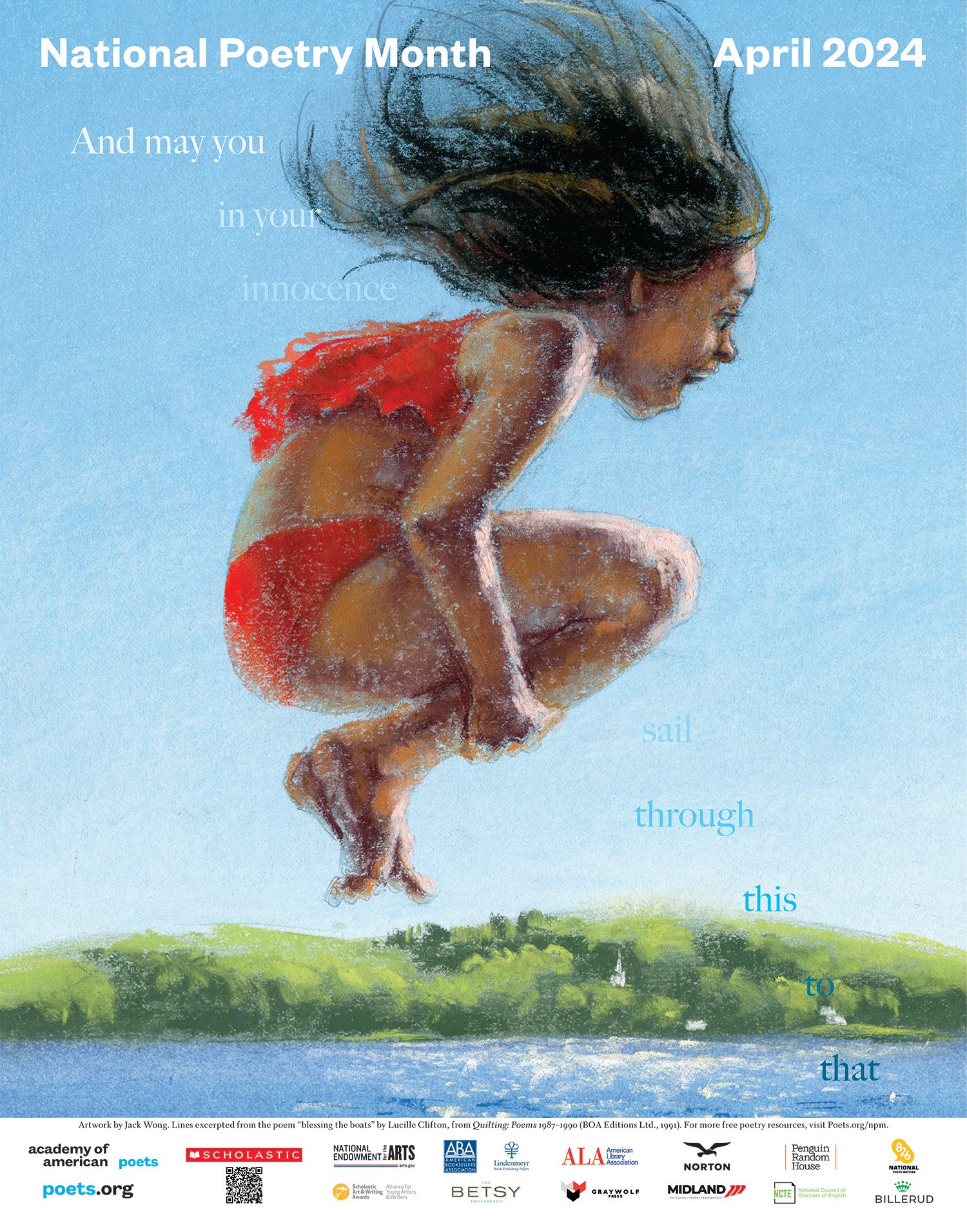
Here we go, poets and poetry lovers! Day one of the poem-a-day challenge and National Poetry Month! So exciting! Read more about it here.
Prompt: Write, without consulting the book, a poem that recounts the plot, or some portion of the plot, of a novel that you like but haven’t read in a long time (compliments of NaPoWriMo)! My today’s effort below.
Ocean moon, photo by the poet
Edna & the Sea
When Edna left the shore &
plunged into the salty blue,
her body slid through breaking waves,
a silvery fish, sunlight flashing freedom.
When Edna left the shore behind
she lost everything—except herself.
When she left the shore, she found herself,
as solid as a whale, breathing air in bursts,
then diving deep, deep, deep into the azure sea.
When Edna returned to
her city home, everything she lost
was there—Victorian rooms, silver trays
with calling cards, tea sets, & callers at the door,
but where was she?
Edna felt the pull of the ocean,
slipped from the shallow talk & society,
she felt the waves wash her ankles,
a moment’s hesitation before the plunge,
like a fish freed from the hook,
frolicking in viridian sea, its escape barely seen.
Jacquelyn Markham 4/1/2024
This plot poem is inspired by Edna Pontellier in Kate Chopin’s The Awakening. If you haven’t read the book, you are missing a classic novel that reveals so much about the lives of women in the 19th century. And frankly, even into the 20th (and maybe even today for some women), Chopin’s words can evoke a “tower moment.”
“Pick a word from the list below. Then write a poem titled either “A [your word]” or “The [your word]” in which you explore the meaning of the word, or some memory you have of it, as if you were writing an illustrative/alternative definition.” The list:
Cage
Ocean
Time
Cedar
Window
Sword
Flute
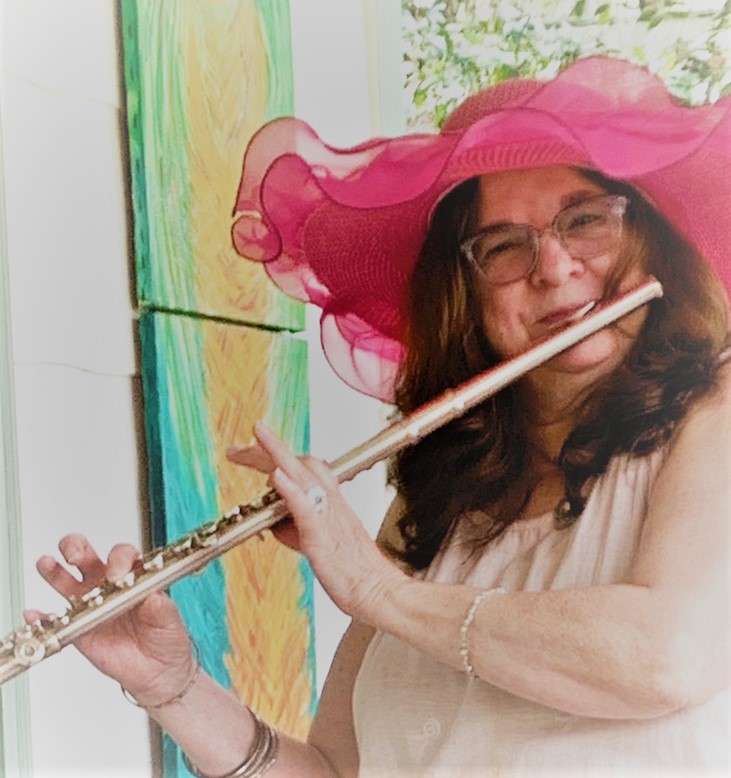
Of course, as a flutist, I certainly must select “flute”!
Can empathy change our world? Can poetry create empathy? I believe the answer to these questions is yes. I would like to share a poem with you that attempts to create empathy for one little island girl who is forced to leave her home–just one of the many stories from my work in progress, Bikini Laments.
Bikini Laments (and Rainbow Warrior, the shorter collection that includes some Bikini Atoll poems) is a series of poems about the impact of atomic testing on the South Pacific islands. The short 1946 film below gives some background on this atomic testing that occurred in the 1940s and 1950s.
My poetry in this collection attempts to create empathy for those whose life and culture on Bikini Atoll were lost. “A Child Speaks to Libokra” tells the story of one little island girl taken from her home as I imagined it. One of the poems from Rainbow Warrior(Finishing Line Press, 2023), it was first published by Hawaii Pacific Review as you see it here.
The shocking story of Bikini Atoll & the Atomic Testing in a brief film:
According to Psychology Today, “Empathy is a sense that you can understand and share the feelings of another.” As I wrote “A Child Speaks to Libokra,” I became the child. I felt I was leaving my palm trees, my sister’s grave, and my simple home behind to board a big ship to the unknown.
In “Myth of the Infinite Sea,” also from Rainbow Warrior, the poet/reader becomes Eagle, hopefully to create empathy for the avian world that experiences oil on the water (specifically, in this poem, the Deepwater Horizon oil spill).
Could our world be saved from violence, war and environmental disasters with more empathy?
If so, I want to do all I can to encourage empathy with my art.
October was as full as its Harvest Moon as it always is in our part of the world after the heat breaks.
I have missed my interaction with friends and readers at Poet Voice, but I am back!
Some of my time was devoted to the 8th Annual Pat Conroy Literary Festival, held every year around the late Pat Conroy’s birthday. I was fortunate this year to take part in a Poets Panel with the amazing sister and fellow poets, Ellen Malphrus, Jennifer Bartell Boykin, and Tim Conroy. What an honor!
Though I was away from Poet Voice for a bit, I also vowed to keep hope alive in my own way with a poem, proving that “poetry matters,” the topic of the poets panel I referred to above.
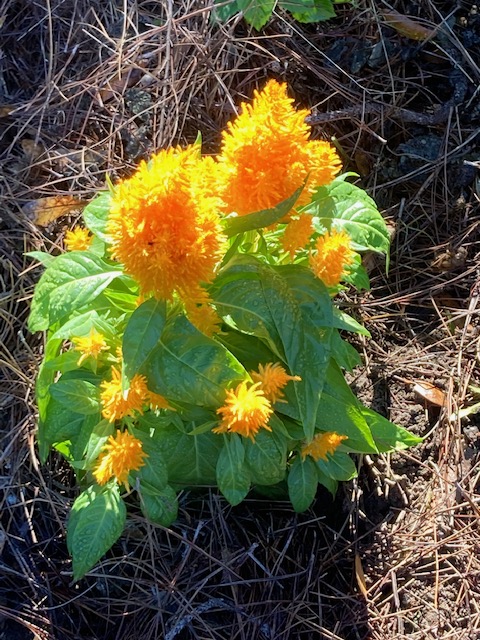
Over time, my most popular blog post was in April during the poem-a-day challenge in honor of National Poetry Month. I wrote and posted “Yellow Celosia of Hope” which was chosen by Maureen Thorson as featured poem of the day on April 27, 2023. (There are many ways to participate in the annual Poem-a-day Challenge; I have been enjoying the camaraderie and prompts on NaPoWriMo, founded by Maureen.
On the April day that I wrote the poem, I did plant a yellow Celosia with “golden feathers,/hope waving from my garden.”
Alas, the hottest summer ever was hard on the beautiful yellow feathery thing! And now, the world over, we need hope more than ever, so I planted two yellow celosias in my fall garden. They are annuals, but in warmer climates may act like a perennial. I will nurture them and replace the symbol of hope as needed. Here again, is the poem:
Yellow Celosia of Hope
I lose hope when the world
loses compassion.
I lose hope when I lose myself or
a belief in the invisible.
I lose hope when I don’t see
love, a solution, or an end.
When I lose hope,
I listen for my heartbeat.
I listen for the wren
announcing dawn.
I look for pinpoints of light
sparkling on the river,
galaxies in the dark sky.
When I lose hope,
I listen to music—loud.
I read the poets, I eat, I drink,
I pace, I cry, I imagine
hope returning.
I cook rice.
I bake biscuits.
I sweep the floor.
I plant Yellow Celosias,
golden feathers,
hope waving from my garden.
Jacquelyn Markham
Dear readers and friends, what ways do you keep hope alive in your lives?
Can we all envision peace together and make a difference as Baba Jolie suggests in her 11/11 portal pick-a card-short video?
Baba Jolie speaks of envisioning peace together
And poets, if you believe as poet Denise Levertov (1923-1997) wrote in her poem, “Making Peace,” that “poets must give us imagination of peace,” then please fire up your imaginations like this Flamma Golden Celosia and let it burn with hope for world peace and harmony in our everyday lives.
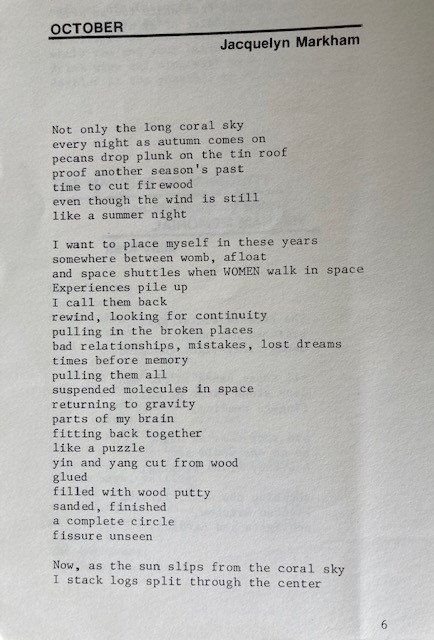
The South Florida Poetry Review, Winter 1985-a black and white view of the old slave quarters I rented from a tobacco farmer, Concord, Florida“October”
Now that Autumn Equinox has come and gone, days will be shorter and nights longer. More time to read, write, and play music through the night! Or, more time to harvest and put away jars of vegetables.
With the cooler temperatures, the winds of change blowing through the oak trees, and acorns dropping on the tin roof, I was reminded of a poem I wrote long ago, “October”–one of two of the first poems I ever published. I was living in a very old cabin, reportedly a former slave quarters, in a community in north Florida, 30 miles from the university where I was working on my doctorate in creative writing and poetry.
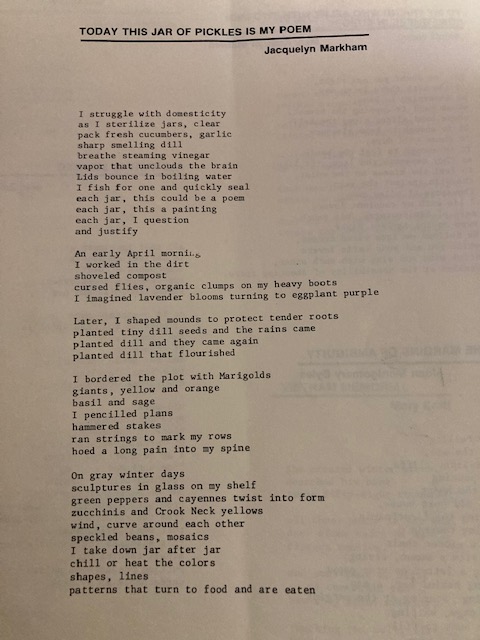
Although I lived in north Florida, the two poems were published in The South Florida Poetry Review, Hollywood, Florida. Sadly, the journal is now extinct though the Florida poetry scene is still vibrant. “Today This Jar of Pickles is My Poem,” which eventually became the title of a prize winning chapbook, was also published in this review. Now, understand, I was at the time growing food and also putting it up in jars for the future. At the time, I believe only 2 % of the population canned their own food and I was among them. Still, I questioned the time taken away from my creative projects.
Last line in second stanza became my dissertation title: “Lavender Blooms Turn Eggplant Purple”
Covid changed all that!
According to garden pals, “The Covid pandemic created 18.3 million new gardeners, most of whom are millennials.”
Check out these amazing statistics about new interest in gardening! That’s good news! What about you?
Does your creative process need a spark? I want to share an approach that taps into your own talents and skills and hopefully will engage some creativity that has gone dormant! I am suggesting a multi-genre or multi-dimensional approach to experiencing your creativity. This approach requires a bold spirit with no bounds on your creative process. Are you ready?
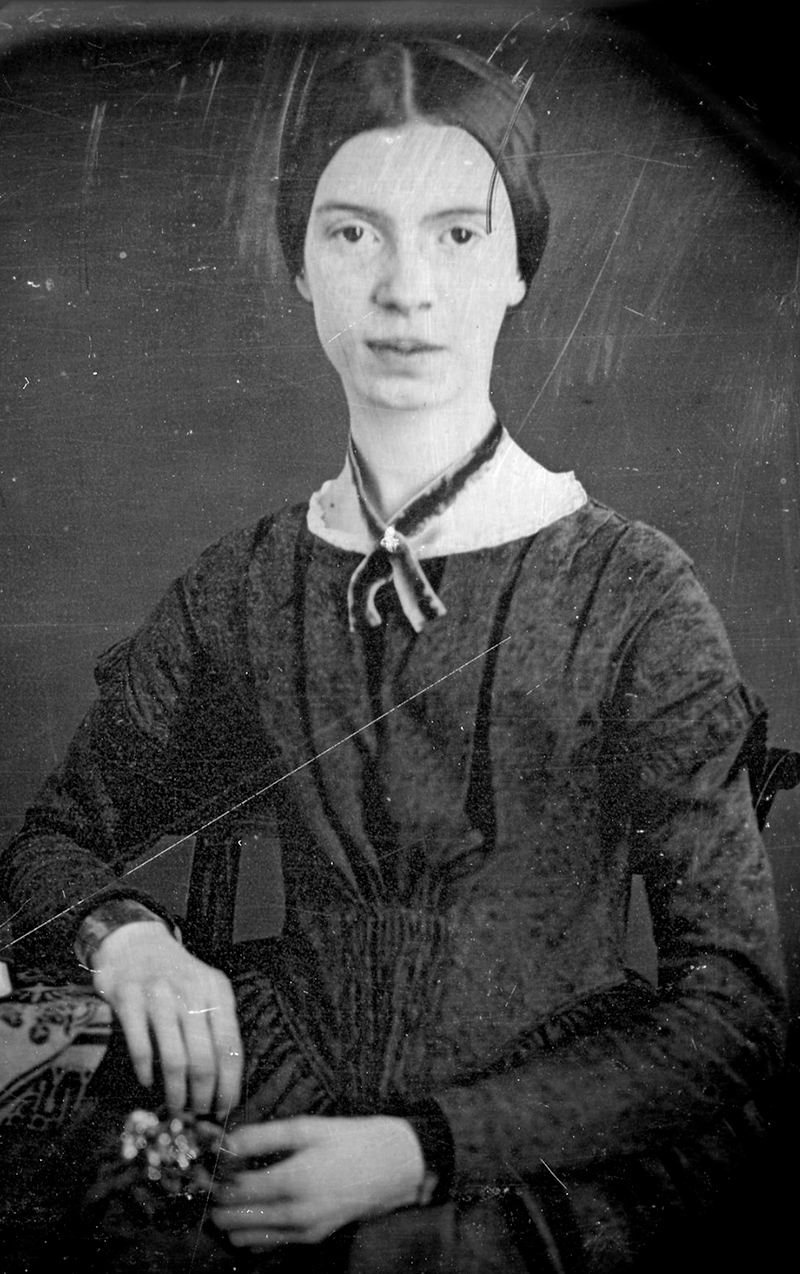
Here’s the way: work with one or more genres of your choice for a multi-dimensional experience of whatever you choose to create. All that is required is a willingness to “dwell in possibility,” as Emily Dickinson did, and embrace the creative process.
First, select a favorite song, painting, poem, story, etc. Next, interpret that work of art in another genre. For example, if you are a painter, create a new painting that interprets a poem or a photograph or a story. A poem may inspire an oral interpretation performance, a dance, a music composition, a drama or even a puppet show!
Sam and Friends, 1955, by Jim Henson
For fun, I explored an interpretation of music with composing and flute playing inspired by Emily Dickinson. My first impromptu musical composition reflected the playfulness of the lines “Two butterflies went out at noon/And waltzed above a stream./Then stepped straight through the firmament/And rested on a beam.” You can imagine the fun I had in playing those two butterflies at noon! When my effervescent energy ran out, I shifted to a minor key for the more foreboding lines “Because I could not stop for Death,/He kindly stopped for me;/The carriage held but just ourselves/And Immortality.” Not to dwell too long on that heavy energy, I decided on the sensual and mysterious lines of “Wild nights! Wild nights!” Click here for the poem provided by The Poetry Foundation including a 33 second recording!
So, I am delving into the poem “Wild nights! Wild nights” in a new way with a musical tone poem to illustrate how this genre bending exercise illuminates the poem with music.
To do this, I chose to use the key of G major because of its key signature with one sharp (F sharp). Note: this may vary from an F to an F sharp, depending on the source. While many “new age” followers are aware of the penetrating power of F#; others may not be, and actually the theory of F# opening the heart chakra goes back to the chanting of monks and is not an arbitrary choice. For this reason, my new experience of Dickinson’s familiar poem became an exploration of the key of G and a repetitive F# and a rhythm that I felt matched the wild waves and emotions of the poem.
Let me say a bit about the “tone poem”–in musical terms.
Dan Farrant at hellomusictheory.com, traced the first use of the phrase “tone poem” to 1828 when the composer Carl Loewe used the word Tondichtung, which means tone poem in German. And interestingly, the piece he composed was inspired by a poem by none other than the dapper Lord Byron! Again, according to Dan at hellomusictheory.com, these musical tone poems (also called symphonic poems) have two essential elements. They are: freer of form (than a concert overture) and inspired by another creative piece or by nature. George Gershwin’s “American in Paris” is a jazz influenced tone poem that truly does tell a story! Have a listen.
-a jazz-influenced tone poem by Gershwin
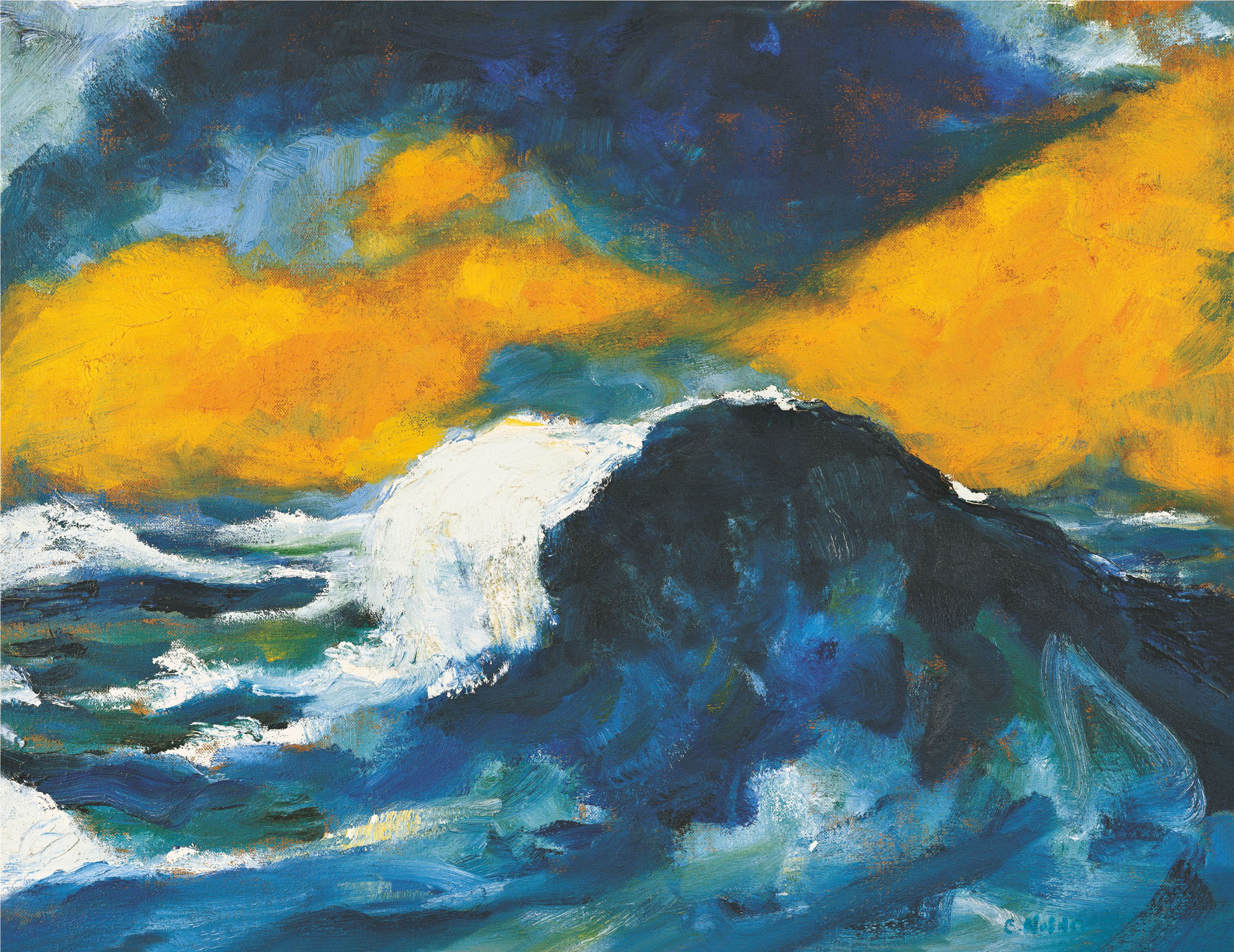
The tone poem suited my experience of Dickinson’s “Wild Nights,” yet I wanted to go deeper, so I created a tiny watercolor to further interpret the poem. It emerged as a colorful abstract image, along the lines of expressionism, like the emotional intensity of a watercolor by Emile Nolde, a German Expressionist known for “the vibrancy of color.” (See his painting “The Sea” above.)
It’s important to note that you need not be a professional in any genre to add a multi-dimensional element to your creative process. I am certainly not a professional composer, but I can expand my creativity by adding an exploration of music to poetry.
As a creativity mentor, I am confident that this process can help to spark your own original voice. Enjoy your creative spark, dear creatives!
How is your Creative Vision PlanTM evolving? Are you pleased with your vision statement and your mission statement? Are you feeding your creativity?
Remember that your vision statement is futuristic and imaginative. Your mission statement is more practical—what you are actually doing or what you want to be doing.
I am happy with both my vision and mission statements, but it did take me some time and tweaking to get there. I even cut pictures out of magazines to create a “vision collage” to make my vision concrete and real. Are you a visual artist or visual learner? This approach may help you.
Finally, with journaling and collaging, I honed my vision statement as follows:
My Vision Statement: To feed my creativity in all genres and mediums. Keep writing and publishing while nurturing streams of income. Work to insure my legacy remains for future generations.
Clearly, my vision is futuristic, even beyond my lifetime—to my legacy. Also, it’s quite general which leaves me lots of leeway with anything I wish to do that “feeds my creativity.”
Next, you have the challenge of writing your personal mission statement. I find this step a bit more difficult as it involves the doing! What am I doing? What do I want to do? Our mission statements guide our everyday life and what we plan to do as well as what we are doing.
Next step, once you have settled on your mission statement, break it into achievable goals and tasks. If you missed my blog on creating your plan, check it out here on July 31, 2023, “Five Steps to Your Creative Vision Plan” for more on this process.
Next steps: Here is the real challenge (at least for me): Staying true to your goals. Good news! They aren’t carved in stone! Adjust as necessary. I am finding that I need to trim my goals a bit and also confession: I did not complete a detailed timeline though I did focus on short term goals through the end of the year. As I refine my plan, I am going to add more detailed tasks and a timeline to keep me on track.
My first goal is the most fun: “Do something creative everyday!”
One of my large watercolors evolving-do something creative everyday!
My second goal is to keep Rainbow Warrior (my latest book of poetry launched in May, 2023) alive and visible. So, I will read a poem or two tonight at the local open mic and share a few lines here with my readers.
Photo & words by poet; lines from “Myth of the Infinite Sea”
And finally, dear readers, please feel free to make comments below about how my suggestions on a creative vision plan worked with your own process.
The waxing moon is in Capricorn until around midnight, July 31, ET (NY) and slides into Aquarius on August 1, Lunar Lammas, a super full moon, the first of two August supermoons! So, wow! lunar energy in abundance as we wind down the summer in full Leo season (in the western hemisphere.)
A new moon rises in Leo on August 16, great energy for focusing on implementing your vision for yourself.
Before we spin around August and enter the moon in Aquarius though, we have a little time to finalize tasks of the Capricorn moon, including setting clear short-term goals (astrological guidance from the We’Moon calendar, learn more here: We’Moon). So, how about a plan for yourself and your creativity?
Does this sound dreary to you creatives out there? Does the phrase Strategic Plan make your eyes glaze over? I understand, but it’s really more rewarding & creative than you might think. Some years ago as an arts consultant for Kentucky Peer Advisory Network (KPAN), I traveled to arts organizations large and small and assisted them with grants, board development, marketing, and yes, strategic planning! That was a great gig except for the driving on mountain roads without guard rails and the long roads to western Kentucky (I was living in Lexington at the time). But, I digress. As an arts consultant, however, I did learn the importance of having a plan to focus your creativity.
My way of making this process of creating a Strategic Plan more fun is to think of it as a *Vision* for my creative life. So, still in the middle of moon in Capricorn, I set about to work on my Vision Plan and finished the details as the clock slipped into today, July 31, while the moon is still in Capricorn.
What about you, dear readers? Want to give it a try? I focused my plan on short term goals from now until December 2023. Here’s the step-by-step process:
Step 1: Write your vision statement. Your vision statement is futuristic and should inspire you. Mine is only three sentences long and I’ve written it in gold ink at the top of a new page in my journal.
Step 2: Next, write your mission statement which differs from but grows out of your vision statement. There are many resources on this process of writing a mission statement (search Strategic Plan) but think simply. What is it you do or want to do everyday? Focus on the present. Keep it brief.
Step 3: Now, short term goals that fit within your vision and your mission. I settled on five, but worked through several pages of writing to see the difference in the goals and the tasks it would take to accomplish them. You could focus on three (a nice number) or more if you are energetic, but I suggest no more than seven. Can some of the short term goals be moved to long term goals, for example?
Step 4: The details, the tasks, the baby steps! What tasks will be needed to meet these goals? (You can break up tasks to smaller baby steps, too.)
Step 5:Create a timeline and in January 2024, review and revise for the new year!
Now that you have carved out the details of your Vision Plan, enjoy the three lunations of August and start to collaborate and network while the moon is full in Aquarius. And always, always, celebrate the fullness and beauty of the full moon and your own accomplishments coming to fruition.
And remember to celebrate your vision plan for the creativity in your life!
This story is a response to a question from Jeff Brown who on the SC Writers Association Facebook feed asked about our favorite piece of writing. I responded:
“I have never thought of having a “favorite piece” of my writing. I write it and it has a life of its own. But, I suppose it would have to be “Story Circle,” a little known and unpublished feminist choreopoem I wrote while at Wolfpen Writers Colony in Prostpect, Kentucky.”
That residency was a month long stay awarded by the Kentucky Women’s Foundation who continues to support women, for example, with the Sallie Bingham Award. That month at Wolf Pen literally changed my life.
So, while I was busy musing on Jeff’s first question, he asked how that experience changed my life. Now, that sent me down another spiral path and here is my musing on that question.
So, other than the obvious—a month away from responsibilities and camaraderie with other writers– it was a combination of cosmic experiences that changed me. Under the dark skies of Kentucky, bonfires throughout the night, a studio far from the living quarters (where my room overlooked a spiral garden), and a library of stimulating material all played a part.
“Story Circle,” my original chorepoem, is about healing & transformation, so the writing of it was healing. Though I had been an advocate for women since the 70s, I began to focus on healing and empowerment in my life, writing, and advocacy.
Poet leading a healing chant in the 1990’s
So when I returned to Athens where I taught at The University of Georgia for 12 years, I was driving down the road when the words “Spiral Dynamics” came to me even though I didn’t know what they meant at the time. Shortly, I founded Spiral Dynamics Women’s Resource and Cultural Exchange. In the 90s women’s studies programs were struggling to be born. Of course, I was on the steering committee for Women’s Studies courses at UGA, but wheels turn slowly in academia and I was impatient, so I founded Spiral Dynamics to promote women’s endeavors–in writing, art, music, and business. Spiral Dynamics never technically become a nonprofit but I simply did whatever I wanted to do, for example, raising money to bring the powerful Luisah Teish, Yoruban priestess to town. It was a memorable time to those who attended with Teish (as she likes to be called) leading us in healing and ceremony.
Spiral Dynamics was quite dynamic for years until it was time to transform the energy into something new. I was hired to implement an SBA grant for a women’s business center, coming full circle since the job was back in Kentucky! I was not an MBA; I was a poet and a professor, but by virtue of my work with women’s businesses through Spiral Dynamics, I was hired. I cut my ties with Georgia and headed into a completely different chapter of my life all from the vision of the spiral garden under my window at the Hopscotch House (Wolf Pen Writers Colony).
And that’s the short story! To be continued in my memoir.
How is your Circling coming along? (See yesterday’s blog post – 7/18.) We have only just begun!
I had an interesting outcome from my Circle activity as I learned my sadness had sprung from my joy and I had lost sight of that joy due to isolation from the heat wave and an attitude that needed adjustment! Ah, a worthy morning of writing, for sure!
This technique of Circling has helped me and many of the people in my workshops to gather together the scattered parts of our lives. Whatever your creative outlet, you can use Circling. Today, add another approach. Draw a larger circle and write around it the names of people, places, or things important to your life. From this simple activity, you may begin to see themes and continuity. In the meantime, you are excavating and collecting a pile of raw material to work from as you dig for the gold!
Only five minutes to devote to creativity at the moment? Add to your Circle. Ten minutes? Choose one of your people, places or things (or joys and sorrows from yesterday) and write continuously for 5 or 6 minutes. Are you ready to devote a few hours? Keep going and repeat the process until as poet Denise Levertov said, “the feeling warms the intellect.” At this point in your process, a poem, story, or painting may appear.
Today we enter the shadow of Venus Retrograde. There are many wonderful and knowledgeable astrologers available to us (as well as books and resources) one of whom is Leah Whitehorse. I learned so much from her interpretation of this planetary event. Venus has been associated with love for centuries, but Venus means so much more than romantic love–love of self, universal love, and all things we value and hold dear. On another day, we will touch on other aspects of the goddess Venus. We have a few months until the planet stations direct and exits the shadow zone!
Venus & Cupid, painted by Artemisia Gentileschi in 1625. The Italian artist depicts sleeping Venus who is wearing nothing except a thin wisp of transparent linen around her thigh. This painting can be viewed at Virginia Museum of Fine Arts, US.
At the same time that Venus enters the shadow zone, the moon in Leo increases urging us to express ourselves and share. (Learn more here from We’Moon)
And planet Earth is doing its part to influence our creativity! Rebelling against mistreatment and neglect, extremes of weather, like heat waves, fires, smoke, and drought impact us as climate change escalates. Our environment, too, permeates our psyche as we create. You may be moved to create a Circle of the Natural World and elaborate on some of it. What moves you to respond: water, birds, trees, mountains, icebergs, polar bears, pileated woodpeckers, the rainforest—Which of these natural phenomena moves you to write, paint, sing, play music for/about?
In my latest book, Rainbow Warrior, available from Finishing Line Press, I both lament the “last Imperial Woodpecker,” extinct from logging (last seen in Mexico in 1956) and celebrate “a rare sighting of Flickers that grace my world./Crescent breast like new moon rising crimson. . .” (“Flicker Montage”).
Spirit Daughter (Jill Wintersteen) is another popular astrologer you may want to check out. She tells us “Where Mercury Retrograde tends to disrupt and confuse mental energy, Venus Retrograde tends to disrupt and confuse emotional energy.” I recommend Spirit Daughter’s analysis too!
In your creative process, try to explore emotions that may surface or those that may stay submerged in confusion during Venus Retrograde (affecting us through October 7). We can also benefit from the increase of creative and physical energy brought on by the moon waxing to full.
Try out the Circling technique from my original journal method as you tune in to moon stars, earth, and self. As I write this and the temperature soars as does our air quality index, I want to return to my Circle of Nourishment and nourish myself as well as extend nourishment to others. I hope you will do the same.
Creatively yours, Jacquelyn
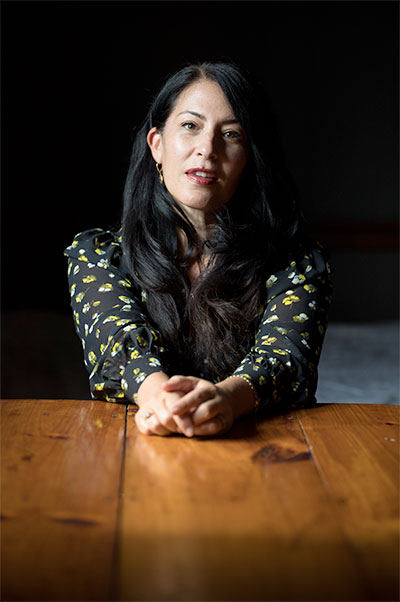
author of Rainbow Warrior, Reclaiming Yourself: A Journal Keeping Approach to the Goddess Within (c1991), & other titles.