

Begin Again!
Begin again. The law is clear
As geologic ages rear
Through curling heat and stiffening cold,
Lost ocean or fresh land unrolled,
We see the new forms still appear.
Nature’s best method triumphs here;
She builds not in one column sheer,
But birth on birth as beads are told
New life we find, rebuilt from old,
Begin again.
Each new day blossoms from the bier
Of night forgotten. Have no fear—
Let us, who are the world, be bold,
Take hope once more, take heart, take hold
Rise now with the new risen year—
Begin again.
Charlotte Perkins Gilman
As we embark on the “unwritten pages of the new,” I draw on the optimism of the the writer, poet, activist, lecturer, artist, and ever industrious, Charlotte Perkins Gilman–who continues to inspire me today.
So much did she inspire me when I first discovered her large body of work that I spent another several decades collecting the poetry that was nearly inaccessible before my book (cover below). Now available at scattered US universities, such as Harvard, Columbia, Boston College, Library of Congress, as well as de la Sorbonne, The British Library, University of Oxford Library, and in Germany and Switzerland (check out Worldcatalog for more locations).

(Mellen Press, 2014)
So, dear readers, I hope you will join me in following Gilman’s inspiration. Her writings are full of poems and stories about beginning again and resolve.
“To keep my health!/To do my work!/To live!/To see to it I grow and gain and give!” (“Resolve”)
As we face the new opportunities and obstacles on our path, let’s adopt her resolve.
“Take hope once more, take heart, take hold” and “begin again”!
Jacquelyn Markham (January 3, 2025)

Dinosaur National Monument with the Milky Way galaxy photographed in the night sky. (Geologic ages explained.)
“New forms still appear”
Lammas, Harvest & too hot to bake?
Like Solstices and Equinoxes, the cross quarter dates can vary a day or two, so you may have celebrated Lammas yesterday on August 1 or you may be celebrating today. Also, as with any holiday that has been celebrated since ancient times, there are so many variations. The cross quarter holidays fall between the change of seasons–fall, winter, spring, and summer, so, as we celebrate Lammas (or Lughnasa as it is also called), let us be grateful for the harvest.
What is important to me today is to celebrate the harvest and bread (lamas is loaf mass). I plan to break out the sourdough starter and put my hands in the dough. I have enjoyed the videos that Hendrik has shared on his channel Bread Code.
If it is just too hot to bake (with climate change and our hot planet earth)! Sit down with a cool drink and watch this vintage film with Meryl Streep that I watched with a dear friend in Long Beach, California now many decades ago.
If it’s too hot to bake, once you have finished watching Meryl Streep, learn about ways to help save the planet from burning up!
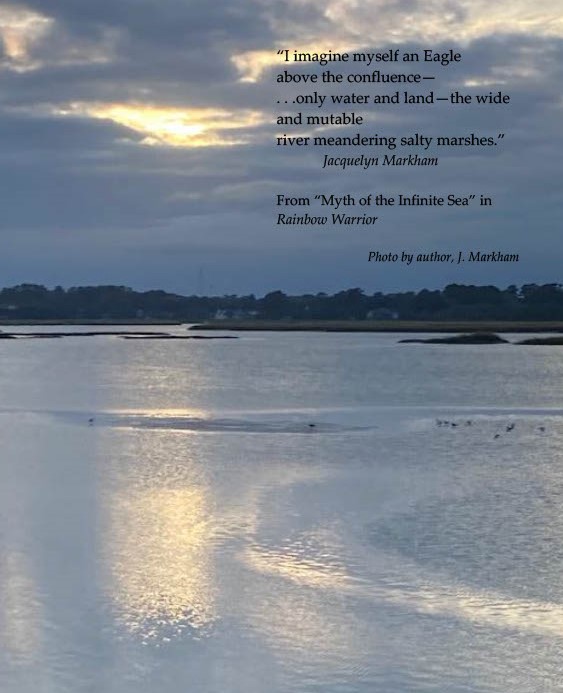
Read full poem in Rainbow Warrior, my latest book of poems, that celebrates nature and calls us to action.
Jacquelyn Markham, Poet Voice
Weaving a Golden Web
A golden orb weaver has moved into a corner of my front verandah and seems quite at home there. She looks as if she has no intentions of ever moving away. Though surely a gift from the universe, if any of you have ever seen this spider, you know that she can be a bit daunting!
According to one website, a group of writers and entymologists who created it out of a labor of love, the golden orb weaver is a “fascinating spider known for its intricate, large webs that shimmer like gold in the sunlight.”
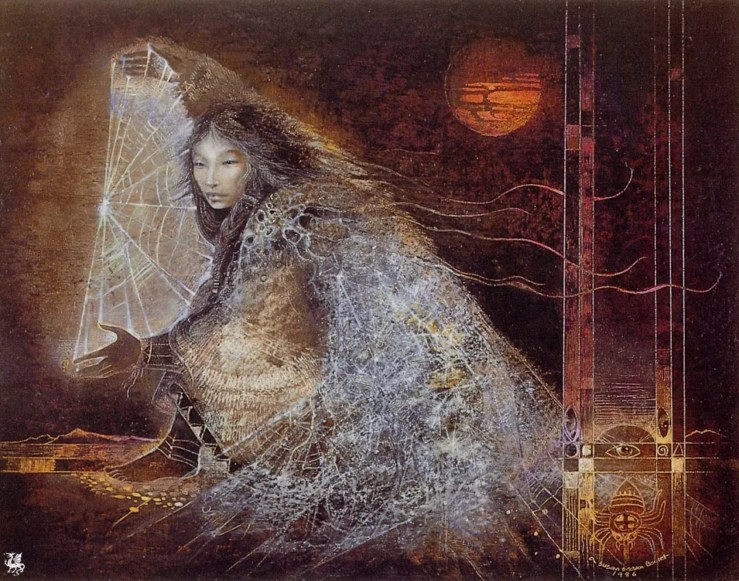
(By the way, if you visit, what’sthatbug.com, be sure to click on the ads which, they explain, help to “generate revenue to pay for hosting, expert entomologists, and bandwidth costs when visitors click on ads on our site.”)
So, alleviating any fears I may have of the amazing golden orb weaver, the information from these entomologists is of interest: “orbweaver spiders are generally non-threatening creatures that pose little risk to humans.” I have noticed that this very large spider is completely oblivious to my presence even when I am watering my porch plants nearby. Whatsthatbug.com continues its “interaction with humans” details: “Their venomous bites are usually harmless, and they exhibit docile behavior in their natural habitats.” For sure, I will not be putting my hand into the web and the Golden Orb Weaver is a very busy spider! She has no time for the likes of me. So, I turn to my usual approach, the symbolism of this “animal spirit.”
Jamie Sams & David Carson in The Discovery of Power Through the Ways of Animals, a guide that accompanies my deck of medicine cards (Bear & Company, Santa Fe, NM), says: “Spider is the female energy of the creative force that weaves the beautiful designs of life.. .If Spider has dropped into your cards (or life, my italics), she may be telling you to create, create, create.”
Spider Woman, popular culture notwithstanding, has been a powerful symbol in some American Indian cultures (Navaho & Hopi), for example, “Spider Woman represented wisdom and education,” according to encyclopedia.com. She is associated with crops, weaving and the goddess as “a symbol of the ability to weave and to create something from one’s own body, just as a spider makes silk” (encyclopedia.com).

Image credit: https://arthive.com/artists/10191~Susan_Seddon_Boulet/works/284690~Shaman_Spiderwoman
So, what does my symbol tell me today? Create, create, create & remember the sheer wonder of our world!

Golden Orb Weaver Spider
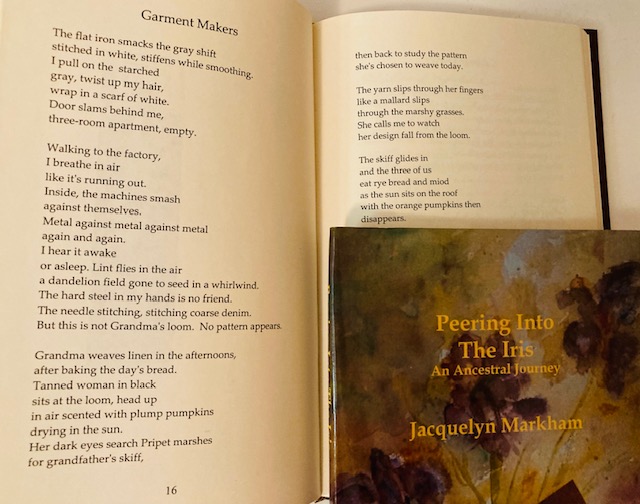
And, dear readers, I will end with a poem from my book Peering Into the Iris: An Ancestral Journey, that tells a story of my ancestors & their weaving.
Get in Touch
Jacquelyn is always available for readings and mentoring poets and writers. If you want to chat about poetry, books, or creativity, don’t hesitate to reach out, make a comment, or send an email to: jacquiepoet3@gmail.com
Listening to Clouds

Be comforted, dear soul! There is always light behind the clouds.”
Louisa May Alcott

When I began to listen to poetry, it’s when I began to listen to the stones, and I began to listen to what the clouds had to say, and I began to listen to others. And I think, most importantly for all of us, then you begin to learn to listen to the soul, the soul of yourself in here, which is also the soul of everyone else.”
Joy Harjo

Sometimes when I am writing, my head is in the clouds. And, I have been writing. Now, I may shift from words to images. These cloud images I took with my simple phone camera, but, I must also paint to really listen, to hear my soul. Below is detail from larger painting titled “Rushgatherers,” inspired by photos of Penn Center, St. Helena, SC (Face of an Island)
(Jacquelyn Markham, poet/painter)

Jacquelyn Markham, poet & writer, author of Rainbow Warrior, Finishing Line Press (2023), Peering Into the Iris: An Ancestral Journey and China Baby, among other titles.
Gladioli from my Garden Against “Abstract Marsh”

(Acrylic on stretched canvas, painted by the author on retreat at Penn Center, St. Helena, SC, ca. 2003)
The continuity of art reveals itself more each year. Images, colors, and themes recur in our writing, painting, photography, cooking, and gardening. So, by chance, when I cut the gladioli from my June garden and placed it in a vase, it gravitated to a painting on my wall. So many times, I have seen in nature like attracts like, for example, yellow butterflies light on yellow flowers.
But, back to the continuity of art. Even in cooking, for example, I have sour dough starter in my refrigerator right now, a baking theme from many years ago when sour dough enjoyed another popularity trend. So, when I was baking bread a week or so ago, I pulled out a poem titled “Bread-Baking” from my collection Lavender Blooms Turn Eggplant Purple (there’s that recurring color!) After some searching, I found the poem and revised it. I’ll share some lines with you here.
Thinking the bread-baking might restore
the home my vagabond dreams threaten,
I set the yeast & the flour in action.
Fingers knead the dough,
punch, pull, stretch until
finally, I shape a smooth loaf,
place it in the bowl,
cover with clean linen.
Time now for its rising.
I wonder as I rest,
steaming tea to my lips,
leaves rustling outside the window,
how yeast turns flour to bread &
what leaven would so wonderfully
transform the early days
into sustenance for the soul?
Jacquelyn Markham (excerpt Bread-Baking)
And, now, it’s June and in my region along with the stunning purple & wine gladioli, we enjoy the abundance of vegetable gardens. So, the other day, I relived another poem, from another time, “Today This Jar of Pickles is My Poem.” This poem became the title poem of a chapbook of the same name that placed as a finalist in a chapbook contest sponsored by what was then Armstrong State College in Savannah (now Georgia Southern University).
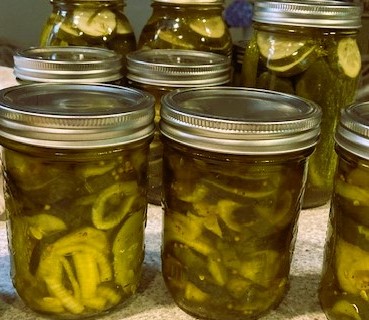
from the poem:
I struggle with domesticity
as I sterilize jars, clear
pack fresh cucumbers, garlic
sharp smelling dill
breathe steaming vinegar
vapor that unclouds the brain
Lids bounce in boiling water
I fish for one and quickly seal
each jar, this could be a poem
each jar, this a painting
each jar, I question
and justify
. . .
On gray winter days
sculptures in glass on my shelf
green peppers and cayennes twist in to form
zucchinis and crookneck yellows
wind, curve around each other
speckled beans, mosaics
I take down jar after jar
chill or heat the colors
shapes, lines
patterns that turn to food and are eaten
Jacquelyn Markham
(excerpt from “Today This Jar of Pickles is My Poem”)
So, today, look around you. Do you see the continuity of art around you? And, the continuity of your life?
Jacquelyn~ aka Poet Voice
Day 30 Heliodora: Gift of the Sun
What a wonderful time I have had with Maureen Thorson’s final prompt for 2024 poem-a-day challenge: “And now for our last prompt of the year – optional, as always! Today, we’d like to challenge you to write a poem in which the speaker is identified with, or compared to, a character from myth or legend. . .” Partly because I have revisited one of my all time favorite poets, H.D. (Hilda Doolittle), modern American poet. Partly because I have learned more about Heliodora, the first known woman astrologer, ca. 2nd or 3rd century.

https://www.poetryfoundation.org/poets/h-d
Heliodora: Gift of the Sun
for H.D., priestess/poet
Heliodora, gift of the sun,
Heliodora, astrologer, were you
the only one?*
You charted Saturn, Mercury & Venus,
on papyrus positioned Jupiter & Mars.
Heliodora, you prophesied births &
guided lovers by planets, by sun.
Heliodora, oracle of constellations,
the moon and its phases. You foretold
mysteries of eclipses, solar & lunar.
H.D., you, too, seeker & seer of mysteries,
poet/priestess, you divined
the memory of Heliodora.
Did she speak to you in a dream?
Did she prophesy in your “writing on the wall?”**
Did Heliodora appear in your “overmind?”
Heliodora, the ancient one,
send me a message through the stars,
the planets, the constellations,
Andromeda, Cygnus, Cassiopeia (the Queen)!
What do you seers foresee for me?
Jacquelyn Markham (4/30/2024)

*Archeology supports evidence of Heliodora, first known woman astrologer in the Greco-Roman world. **See Notes On Thought & Vision by H.D.
***Image of Heliodora courtesy of Missouri Museum of Art and Archeology
Day 29: I envy you your swiftness

Hello poets & lovers of poetry! The penultimate day of our April 2024 poem-a-day challenge has arrived! For this day 29, the prompt asked us as to use as inspiration one of the ten most-used words of singer-songwriter Taylor Swift (really!) in her song lyrics. Her new album Tortured Poets Department hopefully doesn’t represent how we poets feel on Day 29 of the challenge, but we could use some of her publicity!
See the complete prompt from Maureen Thorson’s Napowrimo.net below the poem for more details. I must confess that my use of swift, swiftness, and swiftly was strictly coincidental! After all, I was writing about Mercury!
I envy you your swiftness
If only I were more like you, Mercury.
If only I were more mercurial—in the good sense,
quick-witted, sprightly, clever & ingenious.
Not temperamental, fickle or inconstant,
but swift with missives from the gods!
You wear sandals & a cap with wings
to propel you with a speed that others envy.
Like the planet that bears your name,
you travel lightning fast even escaping
Copernicus by traveling swiftly in the dark!
Not like a tree, rooted in earth,
not like a river running deep & slow,
not like me. I crawl like a caterpillar, a snail,
a turtle from the sea. My mood sets in like
an overcast day when clouds don’t lift
until the sun burns through near sunset.
Oh, Mercury, though you be the god of tricksters
and thievery, and though the slow and steady
win the race, I envy you your swiftness!
Jacquelyn Markham 4/29/2024
The Prompt:
From Napowrimo.net: “And now for our optional prompt. If you’ve been paying attention to pop-music news over the past couple of weeks, you may know that Taylor Swift has released a new double album titled “The Tortured Poets Department.” In recognition of this occasion, Merriam-Webster put together a list of ten words from Taylor Swift songs. We hope you don’t find this too torturous yourself, but we’d like to challenge you to select one these words, and write a poem that uses the word as its title.”
Jacquelyn Markham, poet & writer, author of Rainbow Warrior, Finishing Line Press (2023), Peering Into the Iris: An Ancestral Journey and China Baby, among other titles.
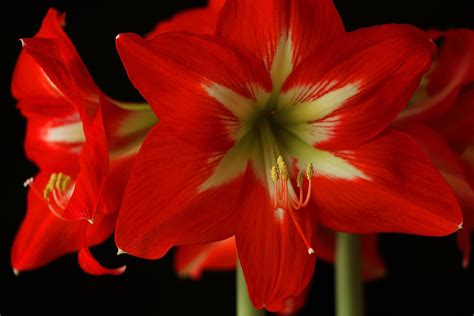
Day 28 Amaryllis Pulse: A Sijo
Happy Sunday everyone! Be good to your muse today! She has been very busy and mostly faithful!
After today’s Sijo, only two more days of the poem-a-day challenge. We are almost there!
Today’s poem is an adventure in counting syllables! And a learning experience.
Mine has 47 syllables, the lines are 16, 16, & 15. This traditional Korean verse form usually has three lines of 14-16 syllables, so I’m within the range. (It is pronounced SHEE-jo.) It’s a little more complicated than just the syllables, so check it out, if you want to know more. I found an excellent guide from Koreanquartly.org—A basic guide to writing sijo, in case you want to try writing one.

The Prompt behind the Poem:
Napowrimo.net: Finally, our optional prompt for the day asks you to try your hand at writing a sijo. This is a traditional Korean verse form. A sijo has three lines of 14-16 syllables. The first line introduces the poem’s theme, the second discusses it, and the third line, which is divided into two sentences or clauses, ends the poem – usually with some kind of twist or surprise.
You could also write a sijo in six lines – at least when it comes to translating classical sijo into English, translators seem to have developed this habit, as you can see from these translations of poems by Jong Mong-Ju and U Tak.
Take a look at this energetic group of women, HerBeat, playing traditional Korean drums! What a pulse of energy like the Amaryllis!!
HerBeat, Korean Women Drummers
Poet, writer, painter, and player of music, I love to express myself and invite your visits and comments to my site. Jacquelyn View all posts by Poet Voice
Day 26 Tango haiku & Be Brave cinquain
Greetings poets & lovers of poetry!
Today’s prompt guided us poets to use several poetic sound techniques—alliteration, consonance, and assonance. I added to that a couple of small poetic forms: the haiku (3 lines of 5, 7, 5 syllables) and the cinquain (5 lines of 2,4,6,8,2 syllables). Fun!
The Prompt from Napowrimo.net: “And now for our (optional) prompt. Today, we’d like to challenge you to write a poem that involves alliteration, consonance, and assonance. Alliteration is the repetition of a particular consonant sound at the beginning of multiple words. Consonance is the repetition of consonant sounds elsewhere in multiple words, and assonance is the repetition of vowel sounds. Traci Brimhall’s poem “A Group of Moths” provides a great example of these poetic devices at work, with each line playing with different sounds that seem to move the poem along on a sonorous wave.”
Tango Till: Haiku
Mango, mango, will
you do the tango till dawn?
Tango me all night.
Jacquelyn Markham 4/26/24
Be Brave: Cinquain
O blue
melancholy
mood melancholy me
sun sparks diamonds on blue river
be brave.
Jacquelyn Markham 4/26/24
Moonflower Mentoring:
Nurture Creativity
Foster Writing Practice
Inspire New Material
Guide Current Projects
Review Mentee’s Work
Dr. Markham uses a variety of approaches to suit each person’s creative process:one-on-one, workshops, and/or intensive programs.In person and virtual options available. To learn more about Moonflower Mentoring:Email: Moonflower Mentoring at jacquiepoet3@gmail.com

