I definitely got carried away with this poem as my idea took me on a long ride. I used gems in alphabetical order and then had to figure out a way to make a poem out of it, simply titled “Gems.”
And here’s the prompt: “Today, I’d like to challenge you to write an abecedarian poem – a poem in which the word choice follows the words/order of the alphabet. You could write a very strict abecedarian poem, in which there are twenty-six words in alphabetical order, or you could write one in which each line begins with a word that follows the order of the alphabet. This is a prompt that lends itself well to a certain playfulness. Need some examples? Try this poem by Jessica Greenbaum, this one by Howard Nemerov or this one by John Bosworth.”
The Academy of American Poets defines “Erasure poetry” as “a form of found poetry wherein a poet takes an existing text and erases, blacks out, or otherwise obscures a large portion of the text, creating a wholly new work from what remains.” (poets.org)
It seems to me that erasure poem could be considered a form of “negation”–the challenge of today’s prompt explained by Maureeen at Napowrimo: “Today’s prompt is a poem of negation – yes (or maybe, no), I challenge you to write a poem that involves describing something in terms of what it is not, or not like.”
Poem removed by Poet Voice for revision and publication elsewhere.
Today’s prompt is another rewrite. Thorson says: “And now for our (optional) daily prompt. Hopefully, this one will provide you with a bit of Friday fun. Today, I challenge you to write a parody or satire based on a famous poem. It can be long or short, rhymed or not. But take a favorite (or unfavorite) poem of the past, and see if you can’t re-write it on humorous, mocking, or sharp-witted lines. You can use your poem to make fun of the original (in the vein of a parody), or turn the form and manner of the original into a vehicle for making points about something else (more of a satire – though the dividing lines get rather confused and thin at times).”
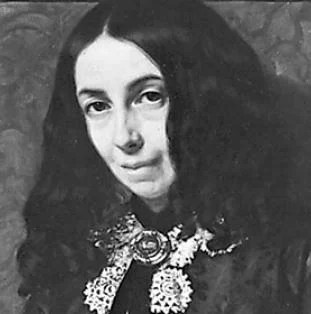
My attempt at the prompt on day 14 has an interesting twist. The poem is not so famous, but the poet is—Elizabeth Barrett Browning. In 1856, Barrett Browning published Aurora Leigh, a “novel in verse” that follows the title character, an aspiring poet, through several pot-boiling twists. In one revealing passage, Aurora’s cousin and would-be suitor, Romney Leigh, summarizes his attitude toward her and women writers of that era in a passage that I quote below. I rewrote that passage.
So, I rewrote the poem from a feminist perspective and titled it “Woman Poet Extraordinaire”
Woman Poet Extraordinaire
Therefore, this same world
that you understand and influence
with your strength and courage will
always be changed by you and
women of the world. Women brave,
strong, and at work in the world
will always change it by their very presence.
You are more than a doting mother and a wife!
You are more than a sublime Madonna ,
a seductress, or an enduring saint.
You are divine!
You are woman!
You are leader, artist, writer,
inventor, healer, builder.
You are poet extraordinaire!
Jacquelyn Markham (4/14/2023)
Here’s the original in which her cousin addresses her, knowing of her aspirations to be a poet:
Therefore, this same world Uncomprehended by you must remain Uninfluenced by you. Women as you are, Mere women, personal and passionate, You give us doting mothers, and chaste wives. Sublime Madonnas, and enduring saints! We get no Christ from you,—and verily We shall not get a poet, in my mind.
The Poetry Foundation explains: “As starkly sexist as the above passage might seem to contemporary readers, the idea that women and female experience were incompatible with poetry continued to hold sway for the next 100 years, until second-wave feminism of the 1960s and 1970s brought a political and cultural watershed. Women fought for equal treatment and civil rights; meanwhile, women poets created structures to support one another while profoundly changing poetry itself.” (www.poetryfoundation.org)
We only have to look at the last two United States Poet Laureates to see “women poets extraordinaire”! Currently, Ada Limon and former, Joy Harjo. Two of my favorite poets.
I once wrote dialogues between the poet and the poem. This prompt is a little like that kind of dialogue, but even a bit more complicated. Here it is from Maureen at Napowrimo: “I challenge you to write a poem that addresses itself or some aspect of itself (i.e., “Dear Poem,” or “what are my quatrains up to?”; “Couplet, come with me . . .”) This might seem a little “meta” at first, or even kind of cheesy. But it can be a great way of interrogating (or at least, asking polite questions) of your own writing process and the motivations you have for writing, and the motivations you ascribe to your readers.”
So here we go. I could go on forever. . .
Whitehall Plantation Oak, painting by poet
Poem removed by Poet Voice for revision and publication elsewhere.
Today is day 7 of the poem-a-day challenge and I’m following Napowrimo (National Poetry Writing Month), the site developed by Maureen Thorson, here’s her prompt for today, Day 7.
A summary of Maureen’s prompt: “Start by reading James Tate’s poem “The List of Famous Hats.” Now, write a poem that plays with the idea of a list. Tate’s poem is a list that isn’t – he never gets beyond the first entry. You could try to write a such a non-list, but a couple of other ideas would be to create a list of ingredients, or a list of entries in an index. A self-portrait (or a portrait of someone close to you) in the form of a such a list could be very funny. Another way into this prompt might be a list of instructions.”
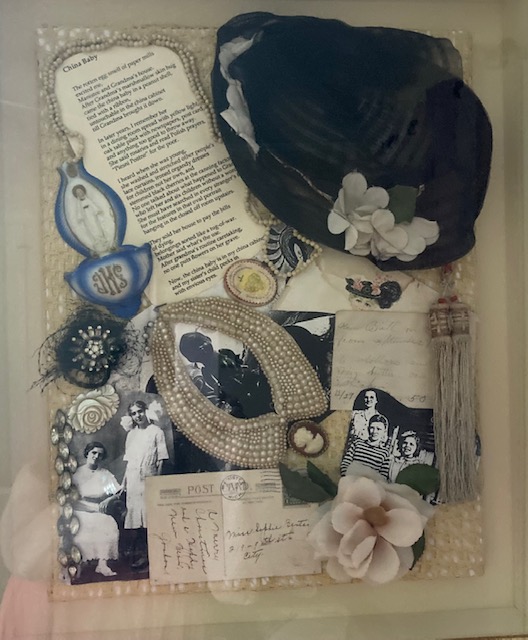
Well, James Tate’s list of hats didn’t go far, but mine did as I wrote about my Grandma’s hats and as you see, she had many! This is a revision of an earlier version of the poem, and I have accompanied it with one of my “Legacy Collages” that features that navy blue hat with flowers and under the hat (not visible because it’s under the hat) is the story from the newspaper when her husband disappeared. What a story/legend it was is!
Poem removed by Poet Voice for revision and publication elsewhere.
Laughing Hyena Image courtesy of aboutwildanimals.com
For day 5, Maureen’s prompt challenged us to “write a poem in which laughter comes at what might otherwise seem an inappropriate moment.” Read more about the prompt here. Don’t miss all the great poetry resources she provides and the many poets who are taking on this challenge of 30 poems in 30 days!
Poem removed by Poet Voice for revision and publication elsewhere.
Thank you for reading. This Day 3 prompt from Maureen Thorson at NaPoWriMo is linked here, but the short version is to take a “shortish” poem and rewrite it by using the opposite word for every word in the poem. It is not as easy as it sounds, but I sort of like this poem I wrote with that crazy prompt: “You aren’t Somebody! Who am I?” Of course, the famous poem by Emily Dickinson, “I’m Nobody! Who Are You?” was the inspiration and I included it below.
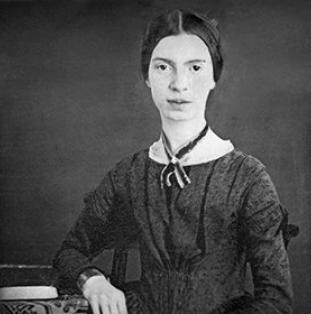
Emily Dickinson (1830-1886) Image courtesy of poets.org
You aren’t Somebody! Who am I?
You aren’t Somebody! Who am I?
Aren’t you Somebody either?
Then there is not an only you!
Tell everyone! We won’t advertise—I don’t know!
How lovely—not to be—Nobody!
How private—like a bird—
Not to tell one’s name—the fleeting December—
To a damning sky!
Jacquelyn Markham (4/3/2023)
I’m Nobody! Who are you? (260)
Emily Dickinson – 1830-1886
I’m Nobody! Who are you? Are you – Nobody – too? Then there’s a pair of us! Don’t tell! they’d advertise – you know!
How dreary – to be – Somebody! How public – like a Frog – To tell one’s name – the livelong June – To an admiring Bog!






 Poet Voice