
Bonjour, Creatives!
Does your creative process need a spark? I want to share an approach that taps into your own talents and skills and hopefully will engage some creativity that has gone dormant! I am suggesting a multi-genre or multi-dimensional approach to experiencing your creativity. This approach requires a bold spirit with no bounds on your creative process. Are you ready?
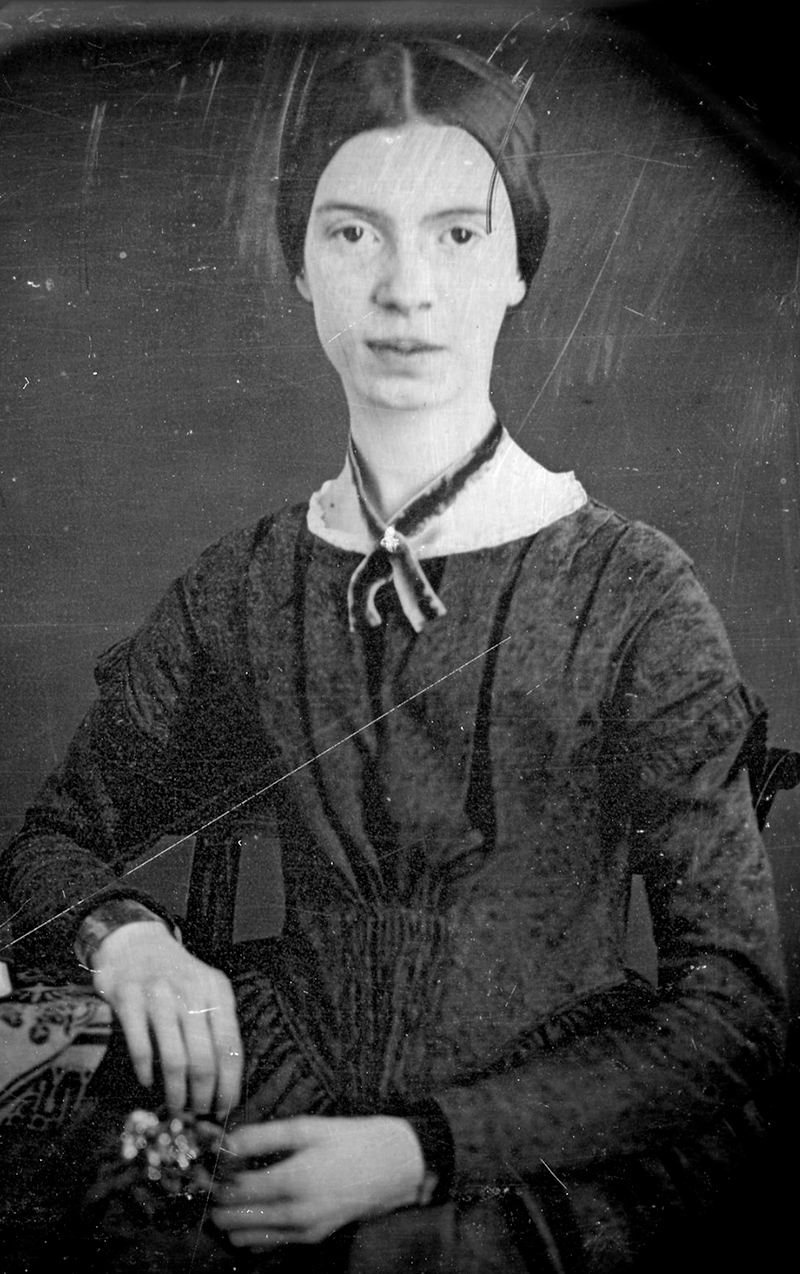
Here’s the way: work with one or more genres of your choice for a multi-dimensional experience of whatever you choose to create. All that is required is a willingness to “dwell in possibility,” as Emily Dickinson did, and embrace the creative process.
First, select a favorite song, painting, poem, story, etc. Next, interpret that work of art in another genre. For example, if you are a painter, create a new painting that interprets a poem or a photograph or a story. A poem may inspire an oral interpretation performance, a dance, a music composition, a drama or even a puppet show!

For fun, I explored an interpretation of music with composing and flute playing inspired by Emily Dickinson. My first impromptu musical composition reflected the playfulness of the lines “Two butterflies went out at noon/And waltzed above a stream./Then stepped straight through the firmament/And rested on a beam.” You can imagine the fun I had in playing those two butterflies at noon! When my effervescent energy ran out, I shifted to a minor key for the more foreboding lines “Because I could not stop for Death,/He kindly stopped for me;/The carriage held but just ourselves/And Immortality.” Not to dwell too long on that heavy energy, I decided on the sensual and mysterious lines of “Wild nights! Wild nights!” Click here for the poem provided by The Poetry Foundation including a 33 second recording!
So, I am delving into the poem “Wild nights! Wild nights” in a new way with a musical tone poem to illustrate how this genre bending exercise illuminates the poem with music.
To do this, I chose to use the key of G major because of its key signature with one sharp (F sharp). Note: this may vary from an F to an F sharp, depending on the source. While many “new age” followers are aware of the penetrating power of F#; others may not be, and actually the theory of F# opening the heart chakra goes back to the chanting of monks and is not an arbitrary choice. For this reason, my new experience of Dickinson’s familiar poem became an exploration of the key of G and a repetitive F# and a rhythm that I felt matched the wild waves and emotions of the poem.
Let me say a bit about the “tone poem”–in musical terms.
Dan Farrant at hellomusictheory.com, traced the first use of the phrase “tone poem” to 1828 when the composer Carl Loewe used the word Tondichtung, which means tone poem in German. And interestingly, the piece he composed was inspired by a poem by none other than the dapper Lord Byron! Again, according to Dan at hellomusictheory.com, these musical tone poems (also called symphonic poems) have two essential elements. They are: freer of form (than a concert overture) and inspired by another creative piece or by nature. George Gershwin’s “American in Paris” is a jazz influenced tone poem that truly does tell a story! Have a listen.
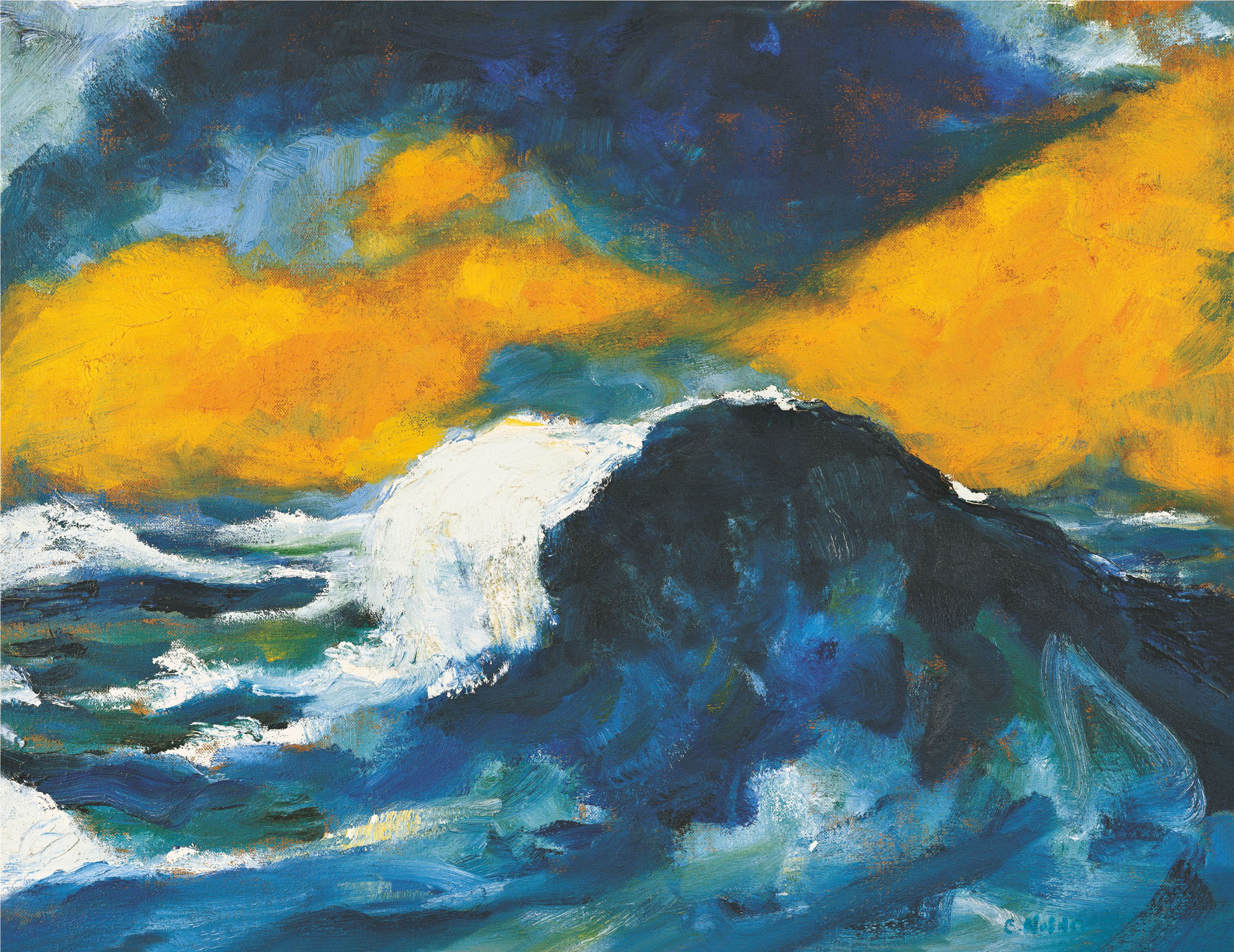
The tone poem suited my experience of Dickinson’s “Wild Nights,” yet I wanted to go deeper, so I created a tiny watercolor to further interpret the poem. It emerged as a colorful abstract image, along the lines of expressionism, like the emotional intensity of a watercolor by Emile Nolde, a German Expressionist known for “the vibrancy of color.” (See his painting “The Sea” above.)
It’s important to note that you need not be a professional in any genre to add a multi-dimensional element to your creative process. I am certainly not a professional composer, but I can expand my creativity by adding an exploration of music to poetry.
As a creativity mentor, I am confident that this process can help to spark your own original voice. Enjoy your creative spark, dear creatives!
Jacquelyn

 Poet Voice